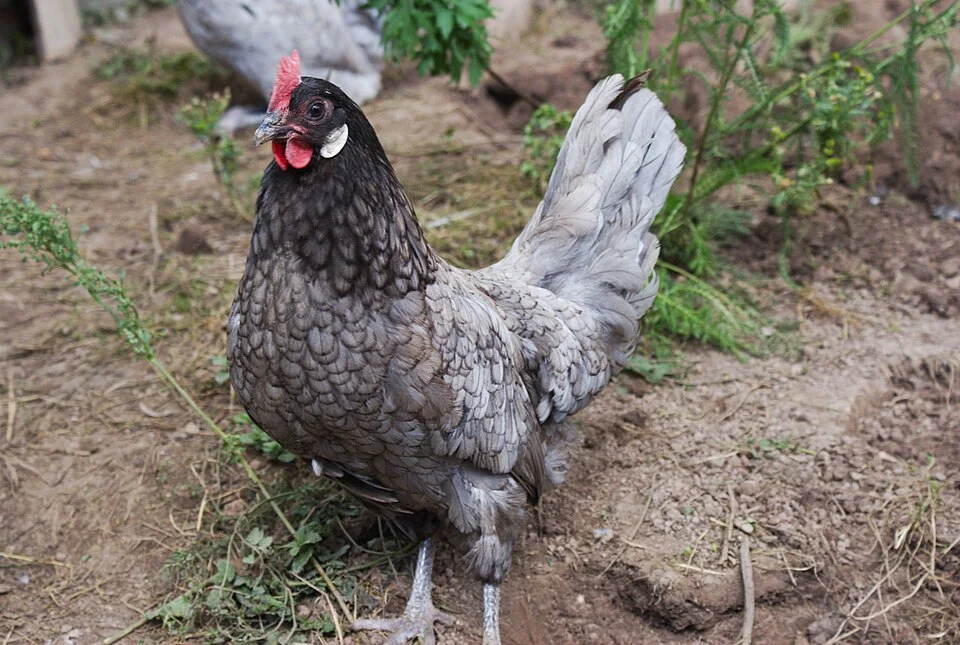
Andalusian is a Spanish Mediterranean breed whose later development in Britain emphasized its distinctive blue plumage. Nineteenth-century imports became a recognized exhibition and laying bird, with the laced blue pattern receiving particular attention. The Spanish regional background and the English selection history are both useful parts of its identity.
That history also explains why blue is the familiar show image while black and splash offspring remain relevant in the breeding pen. Feather color and a bird's value as breeding stock are not the same question.
The desired blue feather is slate colored with a darker edge. Clean slate-blue legs, pale earlobes and a conspicuous red single comb complete the familiar picture. A hen's comb can fall to one side. The body is longer and less rounded than that of many fluffy dual-purpose birds.
Black and splash birds can belong to the same blue-breeding family. Splash is a pale background with irregular darker markings, not simply a poorly washed blue. Study the parent's mating group before treating an unexpected chick color as evidence of a cross.
A useful white-egg layer rather than a frequent broody. Its active nature is an important part of the laying flock's housing plan; the Conservancy cautions that tight confinement can cause problems.
The breed is described as quick to feather and mature, but the sources here do not establish one dependable first-egg week for every flock. Early development and annual egg output should be recorded separately. A fast-feathering youngster is not yet a mature laying hen.
For your pullets, record age at first egg and compare eggs over the same seasonal interval. Andalusian is a white-egg layer with a low tendency to brood; it is not a heavy table-bird project selected for a broiler timetable.
Andalusians favor activity and room to forage. They can be interesting, confident birds without becoming keen on being picked up. A keeper who enjoys observing chickens at work may appreciate them more than someone looking for a quiet lap pet.
Our practical recommendation is to check how the source flock behaves around people and other hens. Allow more than one route away from a dominant bird in the run. Crowing and general flock noise also deserve consideration before choosing this breed for a close suburban boundary.
Plan generous usable space for an active breed, with secure containment above the birds as well as around them. Add sheltered places to investigate rather than assuming bare floor area alone will keep an energetic flock occupied. A predictable coop-return routine is worth establishing while birds are young.
The single comb needs attention in freezing weather, and Spanish ancestry does not make hot-weather care optional. Provide shade and airflow in summer and a dry resting area in winter. Our suggested inspection points are comb condition, litter moisture, water availability and whether every bird can reach a sheltered roost.
With ordinary blue dilution, a blue-by-blue mating is expected over many offspring to produce roughly one-quarter black, one-half blue and one-quarter splash. An individual hatch can look very different from those proportions. Black and splash are therefore part of a sensible blue-breeding program rather than automatic mistakes.
The breeding challenge is more than getting a gray chicken: keep the proper lacing, overall type and useful production. Record parental colors and adult offspring patterns. Our recommendation is to separate color expectations from exhibition eligibility, which depends on the standard used by the show.
Choose Andalusian for white eggs, active foraging and the pleasure of working with blue plumage genetics. It is less convenient where winter comb exposure, a very small run or frequent cuddling drives the choice. Compare Ancona for another active Mediterranean layer and a rose-combed Leghorn if comb form is important. Match the bird to your enclosure before choosing its color.
Keep room for active foraging and protect the exposed comb in hard freezes. Breeding only blue parents does not produce only blue chicks; that is normal color inheritance, not proof of mixed breeding.
These priorities apply the breed traits above to a backyard setup. Use the chick-to-coop planner for young birds and the housing guides for your coop plan.
Questions keepers ask
Why did my blue pair hatch black chicks?
That can be expected from ordinary blue inheritance. Blue-by-blue produces black, blue and splash possibilities. The approximate proportions describe many offspring, so a small hatch need not contain every color. [1][7]
Is splash the same as a white Andalusian?
Splash describes the pale, dark-marked result associated with two copies of the ordinary blue dilution factor. A white-looking bird can have other genetic explanations. Keep the parental mating record instead of identifying the genotype from paleness alone. [4][7]
Are Andalusians a good broody-hen choice?
Usually not. They have little tendency to sit. If natural hatching is a priority, compare a breed known for broodiness or make a separate incubation plan while keeping Andalusians for their laying and ornamental qualities. [1][4]
Can they live somewhere with cold winters?
They can be kept with suitable shelter, but the exposed single comb deserves care during cold, damp conditions. Winter housing and the actual birds' condition matter more than a simple hardy/not-hardy label. [1][5]
Reviewed October 7, 2026. Breed organizations, university references and conservation histories establish breed traits; hatchery estimates describe named supplier lines. This profile identifies the source of the figures instead of treating them as one standardized trial.
Our care recommendations and suggested records apply those traits and Extension husbandry guidance to a backyard flock. They are editorial advice, not results from a controlled breed trial. A breed reputation does not establish an individual bird's behavior, health or readiness to move outdoors.
Egg-size words are source descriptions, not measured carton grades. Adult weights refer to mature birds, not market or pullet weights. Conservation categories describe U.S. populations. Examples of varieties are not a complete list of every national registry's accepted colors.