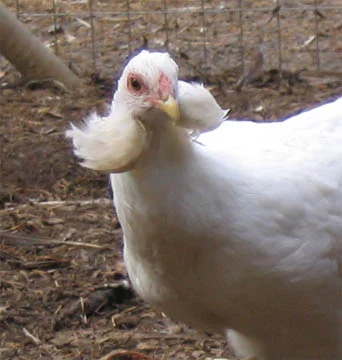
The modern Araucana combines traits associated with Chilean poultry: blue eggs, ear tufts and rumplessness. Those traits were not originally one inseparable package. Breed development brought them together, and subsequent standardization took different directions in different countries.
This profile describes the familiar U.S. rumpless, tufted type. The British Araucana reference includes a different, tailed breed presentation. A purchase described only as “Araucana” therefore needs a country and standard context. Neither an attractive blue egg nor South American ancestry alone resolves that distinction.
Ear tufts are projecting feather-covered appendages near the ears; they are not the cheek muffs of an Ameraucana. Rumplessness is a structural trait, rather than a tail temporarily missing after molt. A pea comb and the appropriate variety's plumage, shanks and body type also matter.
Clean-faced birds can be useful within Araucana breeding flocks even though exhibition requirements differ. When buying chicks, distinguish the description of the breeding flock from a claim that every chick will mature into a correctly tufted show bird.
The Conservancy describes useful laying and a generally docile bird, but preserving the U.S. rumpless, tufted type involves breeding complications. Productivity alone cannot certify purebred ancestry.
The annual egg reference describes productive mature hens, not a guaranteed first-lay date. Our recommended youngster record includes hatch date, growth, tuft expression, tail structure and first egg. Do not combine an ordinary laying timetable with a promised percentage of show-quality offspring.
Araucana hatch results require particular context. Fertility, embryo survival, chick survival and exhibition suitability are separate measurements. Recording them separately gives a much more useful picture than a single “successful hatch” percentage.
The Conservancy describes a mild, curious temperament. That makes the breed appealing to keepers who want interesting hens as well as blue eggs. It does not mean every rooster is safe to handle or every individual enjoys being picked up.
Our practical recommendation is to evaluate personality independently from tuft quality. A calm clean-faced hen may be an excellent backyard companion. A bird's friendliness cannot establish purity, just as a dramatic tuft cannot establish a good fit for a family flock.
Provide dry, weather-protected resting space and observe feather condition during wet or freezing weather. A pea comb reduces exposed comb height compared with a large single comb, but shelter and moisture management remain essential. These are husbandry priorities, not a claim that one unusual feature makes a chicken immune to weather.
For a breeding setup, our recommendation is to make separate mating groups easy to identify and inspect. That helps connect each hatch to its parents and prevents a mixed backyard flock from producing eggs marketed as a specific Araucana mating.
The ear-tuft trait is associated with an autosomal dominant factor whose double-copy form is generally lethal to developing chicks. A tufted-by-tufted mating can therefore lose embryos for genetic reasons; changing the incubator alone cannot remove that risk. Even single-copy birds can have survival problems.
Breeders may use tufted and clean-faced birds together, while selecting for the remaining breed traits. This reduces one genetic risk but does not promise a uniformly tufted hatch. Keep mating, fertility and survival records, and approach the breed as a conservation project requiring informed selection rather than a simple blue-egg cross.
A rewarding breed, with a demanding breeding project
Araucana can suit a keeper who appreciates blue eggs and a distinctive heritage bird. Breeding to the U.S. exhibition type is a more specialized commitment because of tuft-related losses and the combination of required traits. If your goal is simply a friendly colored-egg flock, compare Ameraucana and Easter Egger. Decide whether you want companion hens, preservation stock or a show-breeding project before purchasing.
Ear-tuft inheritance can reduce embryo survival, making breeding a specialist project. Specify the country's standard when discussing identity; the blue shell alone is not enough.
These priorities apply the breed traits above to a backyard setup. Use the chick-to-coop planner for young birds and the housing guides for your coop plan.
Questions keepers ask
Is a clean-faced Araucana automatically an Easter Egger?
No. Clean-faced offspring can occur in Araucana breeding and can have a breeding role. Classification requires parentage and the remaining breed traits. Exhibition eligibility is a separate question from usefulness in a carefully recorded mating. [1][5]
Are Araucana tufts just a beard?
No. Tufts project from appendages near the ears. A beard grows beneath the face, and muffs cover the cheeks. Confusing them hides an important genetic and identification difference between Araucana and Ameraucana. [5]
Does every Araucana anywhere have to be rumpless?
No. National standards differ. The U.S. breed presentation described here is rumpless and tufted, while the British reference has a different type. State the country and standard when comparing birds or planning an exhibition entry. [2][5]
Why can a fertile Araucana egg fail to hatch?
Fertility does not guarantee embryo survival. Ear-tuft inheritance can contribute to losses before hatch, alongside ordinary incubation and flock-health factors. Keep a record of the parental mating and the stage of loss instead of attributing every failed egg to incubator settings. [4][5]
Reviewed October 7, 2026. Breed organizations, university references and conservation histories establish breed traits; hatchery estimates describe named supplier lines. This profile identifies the source of the figures instead of treating them as one standardized trial.
Our care recommendations and suggested records apply those traits and Extension husbandry guidance to a backyard flock. They are editorial advice, not results from a controlled breed trial. A breed reputation does not establish an individual bird's behavior, health or readiness to move outdoors.
Egg-size words are source descriptions, not measured carton grades. Adult weights refer to mature birds, not market or pullet weights. Conservation categories describe U.S. populations. Examples of varieties are not a complete list of every national registry's accepted colors.