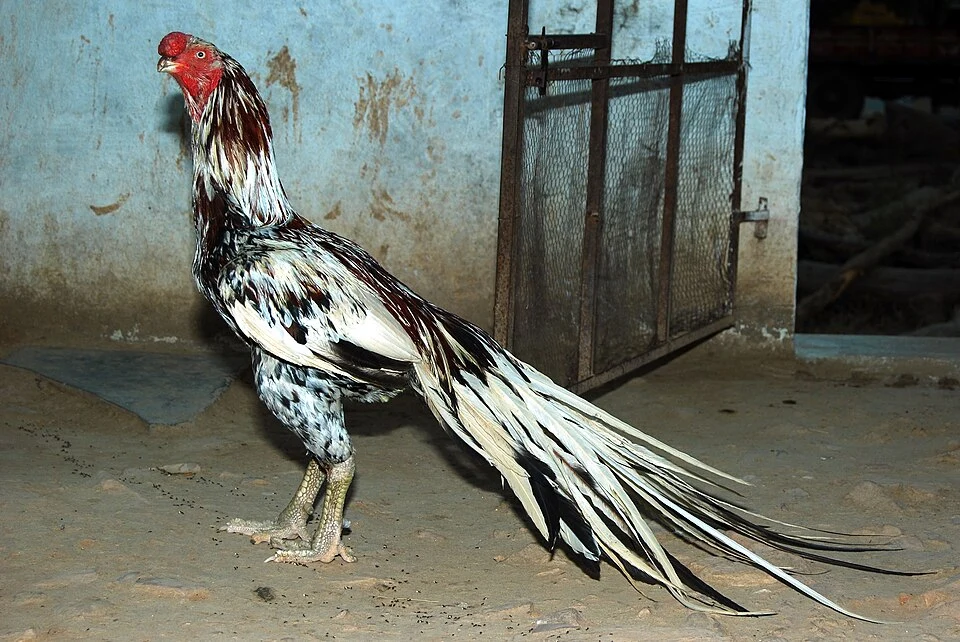
South Indian long-tailed Aseel type; regional forms differ from U.S. and British standards. Vyas16muthu · CC BY-SA 3.0 / original photograph
Indian subcontinent; distinct regional and national types · Breed
Aseel
A muscular, close-feathered breed with deep South Asian roots. Its conservation value comes with demanding flock-management needs and important regional distinctions.
Egg color
Off-white to light brown
Annual eggs
6–40
Adult size
Conservancy: hen 4 lb; rooster 5.5 lb
Broodiness
Strong sitting and maternal reputation; individual behavior matters
Have Aseel in your flock?Your everyday experience could help someone choose their next chickens.
U.S. conservation population, 2026 list. This is not a worldwide extinction-risk rating.
An old South Asian breed with several forms
Aseel, also spelled Asil, has deep roots in the Indian subcontinent. Its historical game-bird selection helps explain its muscular build and demanding flock behavior. Present-day conservation keeping should focus on preserving sound birds and their identity with safe, humane management.
Regional and national forms matter. The smaller Asil described by the British club is not a universal weight reference for all birds called Aseel. American recognized varieties and South Asian regional types also need their own context. Keep the actual type with the bird’s record rather than treating every spelling and photograph as one uniform population.
Muscle and close feathering, with context for size
Typical descriptions emphasize a compact muscular body, close hard feathering, a pea or triple-type comb and small head appendages. Strong clean legs, often yellow in the U.S. reference, complete the impression. A vigorous-looking silhouette does not itself demonstrate good health or correct breeding.
The Conservancy gives 5.5 pounds for a male and 4 pounds for a female; Oklahoma State gives 6 and 5 pounds respectively. Those references differ, and this page does not average them. The photograph shows a documented South Indian long-tailed type; it is not presented as certification of a U.S. exhibition specimen or a British small Asil.
The British club explains that its standard concerns the small Asil and that Reza refers to birds in the 3½–4-pound context. That is another reason to retain the actual type name. It is not a new combined weight range for all South Asian Aseel or an interchangeable label for every regional form.
The Conservancy describes 6–40 small pale eggs annually, alongside strong broodiness and maternal behavior. OSU describes low seasonal laying. The low total fits the breed's historical selection and does not mean an otherwise well-cared-for hen should be expected to match a production hybrid.
The Conservancy describes slow growth. Do not evaluate Aseel on a meat-hybrid timetable, or assume muscular adults make chicks easy to rear. Closely observe young birds’ movement, access to resources and interactions. Make separation possible before an aggressive encounter creates the need.
Record hatch date, regular weights and consistent photographs for each family. That record is more useful than comparing a youngster with a dramatic photograph of an unrelated adult type. The cited sources do not establish one first-lay age across regional forms. Sexual development, physical growth and the ability to coexist safely must be assessed separately.
Aseel can form a close relationship with a handler while remaining highly aggressive toward other chickens. Young birds can begin sparring early, and females also require careful management. A friendly greeting to you is therefore not evidence that a bird belongs in a shared pen.
Prepare separate secure accommodation and an uncomplicated daily routine before bringing birds home. Check interactions actively rather than relying on a breed’s general reputation. A person covering chores must understand which birds remain separate and how to move them safely. The practical management burden is part of the breed’s identity, not an optional detail added after choosing a favorite color.
Create pens that allow observation, movement and reliable separation. Avoid a design that makes every feed visit depend on catching or moving another bird first. Evaluate the actual bird’s dimensions, including regional differences, before choosing openings, nests or handling spaces.
Warm-weather suitability still requires shelter, shade and dependable access to water. Close feathering and a muscular body do not establish disease immunity or remove the need for daily care. Keep each pen easy to inspect and maintain. The housing should support sound movement and calm routine handling, rather than merely displaying an impressive adult through a fence.
The Conservancy describes 6–40 small pale eggs annually, while Oklahoma State emphasizes low seasonal production and strong sitting behavior. That differs fundamentally from a flock selected for maximum annual eggs. Record the actual hen’s laying and hatch outcomes rather than treating low output as a failure to meet a hybrid’s target.
A protective mother does not automatically make a communal family pen safe. Assess the hen, clutch, chicks and neighboring adults separately. Retain parent identities and regional type in the breeding record. Aseel influenced other poultry development, but a cross involving Aseel is not automatically a preserved Aseel population or an interchangeable Cornish.
Choose Aseel when you understand its type distinctions and can sustain specialist management. It is a compelling conservation project, but generally a poor fit for a beginner seeking an easygoing mixed layer flock, high egg totals or a simple community broody pen.
Compare Malay and Shamo for related housing and behavior demands, while keeping each breed’s traits separate. The 2026 U.S. Critical status concerns a conservation assessment of the U.S. population. Your contribution depends on documented stock and responsible breeding, including fertility and soundness records, rather than acquiring an unusual-looking bird alone.
Have separate secure pens ready before chicks or adults arrive. Track the exact type and pedigree, watch females as well as males, and put sound movement and calm human handling ahead of appearance alone.
These priorities apply the breed traits above to a backyard setup. Use the chick-to-coop planner for young birds and the housing guides for your coop plan.
Questions keepers ask
Are Asil and Aseel searchable as the same name?
Both spellings lead here. The page still distinguishes regional and national forms rather than assuming one universal size or appearance. [1][3]
Does friendliness to me mean safety with other chickens?
No. Human attachment and aggression toward other birds can coexist. Keep a secure separation plan for adults and young birds. [1][2]
Why are two adult-weight references shown?
The sources differ, and the British small Asil is another context. Preserving those distinctions is more useful than averaging unlike references. [1][2][3]
Is a broody Aseel a guaranteed safe communal mother?
No. Strong maternal behavior does not establish compatibility with neighboring adults or every chick arrangement. Observe the hen and manage the family separately when needed. [1][2]
Reviewed October 8, 2026. Breed organizations, university references and conservation histories establish breed traits; hatchery estimates describe named supplier lines. This profile identifies the source of the figures instead of treating them as one standardized trial.
Our care recommendations and suggested records apply those traits and Extension husbandry guidance to a backyard flock. They are editorial advice, not results from a controlled breed trial. A breed reputation does not establish an individual bird's behavior, health or readiness to move outdoors.
Egg-size words are source descriptions, not measured carton grades. Adult weights refer to mature birds, not market or pullet weights. Conservation categories describe U.S. populations. Examples of varieties are not a complete list of every national registry's accepted colors.