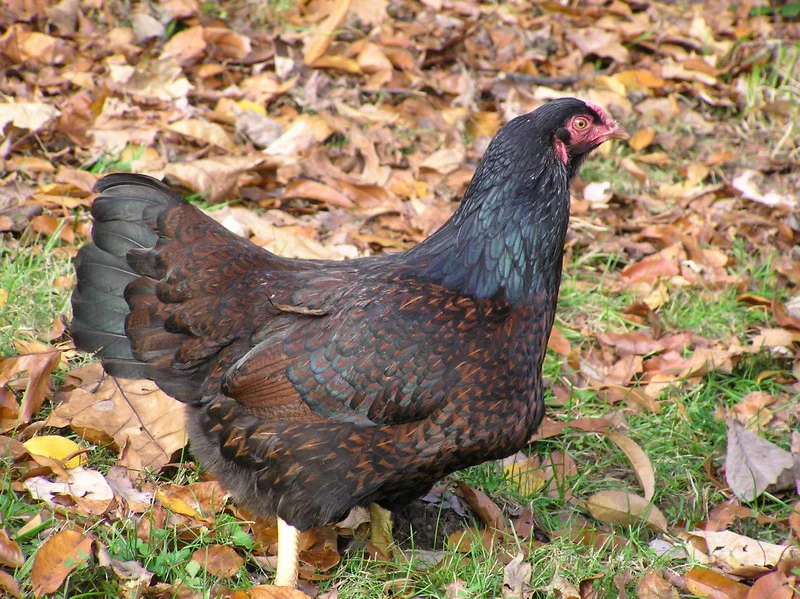
Cornish developed in Britain and was formerly called Indian Game. Its original game-bird background gave way to a reputation for a muscular table-bird type. The compact, broad breast is central to its identity, while its usefulness as a high-output egg layer is limited.
The heritage Cornish breed and a commercial Cornish Cross broiler are different birds. A cross uses selected parental lines to achieve a particular production result. Its fast processing timetable cannot be applied to the heritage breed simply because both names contain “Cornish.”
Cornish has close, firm feathering, a broad muscular front, widely placed short legs and a pea comb. Dark is the familiar patterned variety, but white and other varieties exist under different registry descriptions. Males and females share the characteristic body type even where plumage differs.
The large-fowl weights in the fact grid are mature reference weights. They are distinct from processing weights and bantam figures. Our practical recommendation is to evaluate movement and balance as carefully as width: an impressive breast does not by itself establish a sound breeding bird.
The reference describes fewer than 160 eggs a year. A broad, muscular standard Cornish is primarily a table and breeding bird, not a high-output layer or a substitute for a commercial broiler cross.
The heritage breed grows more slowly than commercial Cornish Cross. Plan feed and space accordingly instead of assuming a short broiler project. First laying, mature body development and a processing decision are separate milestones.
The egg figure is explicitly an upper limit: “fewer than 160” is not a range beginning at 160. Our suggested flock record includes growth, actual annual eggs and hatch results. That lets the breed's table and breeding qualities be evaluated without pretending it is also a high-output layer.
Temperament descriptions vary. Some Cornish can be manageable with people, while individuals may be assertive toward other birds and some males can be aggressive. A “docile” summary should not override what you observe in the flock.
Our recommendation is to monitor introductions closely and retain a separation option, especially alongside quiet, smaller birds. Assess adult males individually before allowing close family interaction. Choose flock mates and resource spacing with the breed's substantial front and short-legged movement in mind, not just the color variety.
Provide low, stable roost access, roomy nesting arrangements and a clear landing area. Check that a broad bird can pass through the doorway and reach feeders without squeezing or stretching awkwardly. These are practical applications of its body shape.
Close feathering does not provide the same insulation as a fluffy breed, and a heavy muscular bird still needs hot-weather relief. Our suggested priorities are protection from cold rain, summer shade, airflow and easy water access. Predator protection must come from the enclosure; limited flight and slow movement are reasons to make it dependable.
Cornish hens may become broody, but their substantial bodies can make egg breakage a problem. Watch the actual sitting setup and outcome rather than assuming broodiness guarantees a successful hatch. Fertility also needs direct recording in a short-legged, heavily muscled breeding flock.
Our suggested selection record combines type, movement, mature condition, fertility and chick development. Keep heritage-breed matings distinct from any crossbred meat project. This preserves honest labeling and makes a disappointing result easier to interpret than an unrecorded flock of mixed “Cornish” birds.
Cornish suits a keeper interested in the traditional muscular type, exhibition or a carefully managed breeding project. It is less suited to someone primarily seeking many eggs or a very short meat-growing timetable. Compare New Hampshire for a more balanced dual-purpose bird. Confirm whether a seller means the heritage breed or Cornish Cross before making housing, feeding and processing plans.
Standard Cornish is distinct from Cornish Cross. Do not apply a fast-growing broiler's slaughter age, body expectations or management schedule to this heritage breed.
These priorities apply the breed traits above to a backyard setup. Use the chick-to-coop planner for young birds and the housing guides for your coop plan.
Questions keepers ask
Is Cornish the same as Cornish Cross?
No. Cornish is a standardized heritage breed. Cornish Cross describes a commercial meat hybrid or crossbred production bird. They have different development expectations, and the shared name is not a reason to use the same timetable. [1][3]
Does a pea comb make Cornish especially cold hardy?
No. Comb size is only one trait. Close feathering and overall body structure also matter. Provide appropriate shelter and inspect comfort rather than deciding winter suitability from the comb alone. [1][5]
Can Cornish hens hatch their own eggs?
Some go broody, but their size and short-legged structure can contribute to broken eggs. Evaluate the nest, the hen's sitting behavior and actual hatch results. Broodiness and successful incubation are separate observations. [1]
Does “fewer than 160” make it a 160-egg layer?
No. That statement gives an upper limit. It should not be turned into a minimum or a guaranteed output. A recorded year from your own flock is the useful comparison. [1]
Reviewed October 7, 2026. Breed organizations, university references and conservation histories establish breed traits; hatchery estimates describe named supplier lines. This profile identifies the source of the figures instead of treating them as one standardized trial.
Our care recommendations and suggested records apply those traits and Extension husbandry guidance to a backyard flock. They are editorial advice, not results from a controlled breed trial. A breed reputation does not establish an individual bird's behavior, health or readiness to move outdoors.
Egg-size words are source descriptions, not measured carton grades. Adult weights refer to mature birds, not market or pullet weights. Conservation categories describe U.S. populations. Examples of varieties are not a complete list of every national registry's accepted colors.