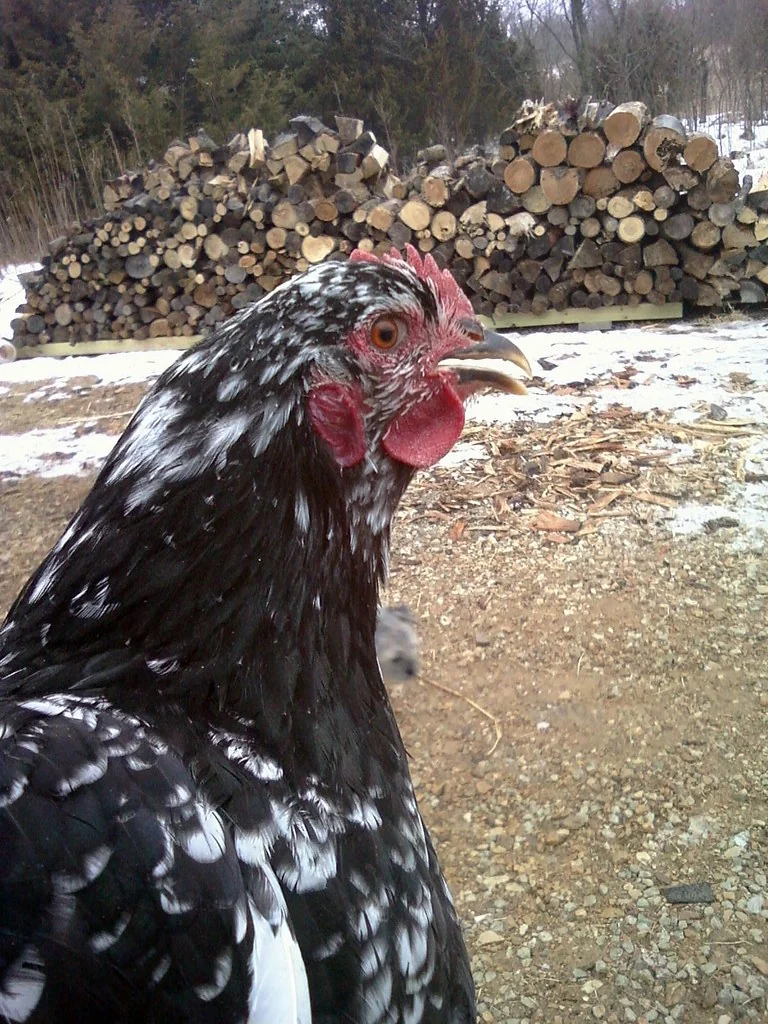
Java is one of the oldest chicken breeds developed in America. Its earlier imported ancestry is less certain than its documented American development, and the name should not be taken as proof that the modern breed arrived unchanged from the island of Java.
It contributed to later American breeds, including Plymouth Rock, Jersey Giant and Rhode Island Red, which eventually overshadowed it. Its preservation interest lies in retaining a distinct working breed, rather than simply collecting black chickens with a shared ancestral connection.
Java has a long, broad body, a sloping topline and a single comb. Black and mottled are the familiar recognized American varieties. White and auburn also belong to its history and preservation discussion, but existence and registry recognition should not be treated as identical claims.
Black birds may show a striking green sheen; mottled birds carry white markings on a dark background. Our practical recommendation is to examine body, legs and mature size as well as plumage. A black feathered bird alone does not establish Java rather than Australorp or another breed.
The Conservancy gives 150–180 eggs, slower development and useful brooding. Its long farm history and conservation role may matter more to a keeper than competing with a production hybrid's output.
Java develops more slowly than modern fast-growth poultry. Its adult size, processing weights and laying stage should be recorded separately. The reference does not supply a universal first-egg week, so a fixed calendar would imply more precision than the evidence provides.
Our suggested youngster record tracks hatch date, growth, first laying and later body condition. Compare birds raised under similar conditions. A slower-growing preservation bird should be evaluated against its own project goals rather than rejected because a specialized hybrid reaches a market milestone sooner.
Javas are generally described as calm and manageable, although youngsters may be more flighty. They enjoy ranging and foraging. This can suit a keeper who wants a personable heritage flock without expecting each chick to behave like a fully familiar adult.
Our recommendation is to establish calm daily contact and observe adult behavior around both people and other birds. Keep access to feed and water visible in mixed groups. A farm-breed reputation is useful for shortlisting, but it does not make every rooster or every introduction predictable.
Provide an activity area that accommodates normal movement and an accessible nighttime shelter. Our suggested layout avoids narrow doors and crowded feeder approaches as birds reach mature size. Foraging ability does not replace secure feed storage or a complete feeding plan.
Java hens are described as cold-tolerant, while large male single combs may need additional attention in freezing weather. Keep dry resting space and reliable water available. In summer, provide shade and airflow. Evaluate the occupied coop, not only its advertised bird capacity or an attractive empty interior.
Preservation involves maintaining Java type and a useful breeding population, not reconstructing one from its descendant breeds. Keep variety identity and parent groups recorded. Mixing Rhode Island Red or Plymouth Rock into a pen creates a cross project, even when those breeds share historical ancestry.
Our recommended records include mature body, growth, eggs, broodiness, fertility and hatch results. Java hens can be useful mothers, so track successful chick rearing alongside production. Retain family contributions rather than letting one especially attractive male represent the entire next generation.
Java suits someone with space, an interest in American poultry history and patience for traditional development. It is less convenient when immediate high-output laying or a short meat-growing project is the sole goal. Compare Plymouth Rock, Australorp and Jersey Giant to understand the alternatives. Choose identified Java stock if preservation matters; visual resemblance and historical connections are not sufficient substitutes.
Allow time for slower development and provide space for foraging. Keep records of variety and parentage when helping conserve a rare breeding population.
These priorities apply the breed traits above to a backyard setup. Use the chick-to-coop planner for young birds and the housing guides for your coop plan.
Questions keepers ask
Did modern Javas come unchanged from Java island?
The earlier ancestry is uncertain; the breed was developed in America. The geographic name is not evidence for a complete, unchanged island origin. Distinguish the documented breed development from uncertain imported ancestry. [1]
Are all Java color varieties equally recognized?
No. Black and mottled have recognized American standard status, while white and auburn have different historical and preservation contexts. State the registry and variety rather than treating every existing color as identically classified. [1]
Can I recreate Java by mixing its descendant breeds?
That would create a new cross, not automatically restore Java identity. Shared ancestry does not preserve the original combination of type and breeding characteristics. Use documented Java stock for a preservation project. [1][5]
Are Javas useful for natural flock replacement?
Some hens are broody and good mothers. Record the actual sitting, hatch completion and chick-rearing results. Those observations are more useful than assuming every hen will provide the same maternal contribution. [1]
Reviewed October 7, 2026. Breed organizations, university references and conservation histories establish breed traits; hatchery estimates describe named supplier lines. This profile identifies the source of the figures instead of treating them as one standardized trial.
Our care recommendations and suggested records apply those traits and Extension husbandry guidance to a backyard flock. They are editorial advice, not results from a controlled breed trial. A breed reputation does not establish an individual bird's behavior, health or readiness to move outdoors.
Egg-size words are source descriptions, not measured carton grades. Adult weights refer to mature birds, not market or pullet weights. Conservation categories describe U.S. populations. Examples of varieties are not a complete list of every national registry's accepted colors.