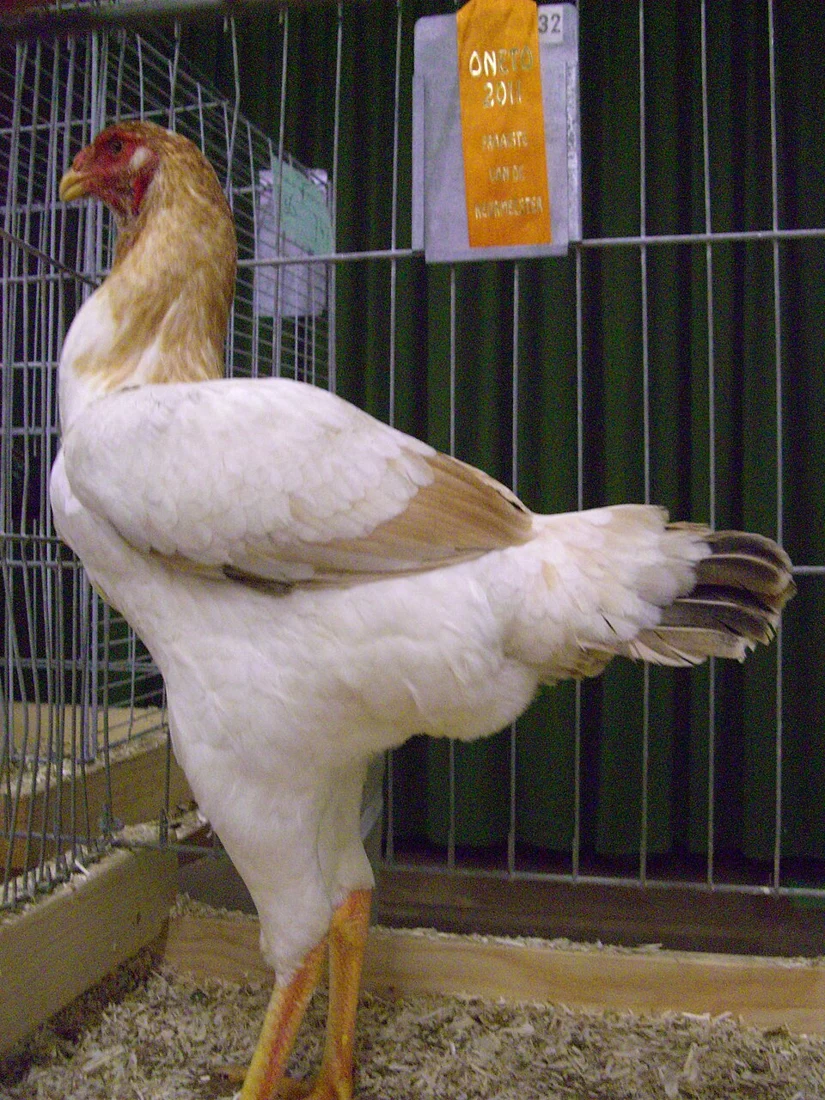
Asia; long-established European standard development · Breed
Malay
One of the tallest chicken breeds, with close feathering and a compact comb. Plan for its carriage, movement needs and flock behavior before its impressive silhouette.
Egg color
Brown to tinted brown
Annual eggs
20–100
Adult size
Hen 7 lb; rooster 9 lb
Broodiness
Can brood; limited egg coverage and male-chick risks
Have Malay in your flock?Your everyday experience could help someone choose their next chickens.
Large fowl and bantam; national weights differ [3]
Development
Do not equate adult height with early maturity. The sources distinguish delicate chicks from hardy adults but do not establish a single first-lay week. [1]
U.S. conservation population, 2026 list. This is not a worldwide extinction-risk rating.
A tall Asian breed with a long standard history
Malay has deep Asian ancestry and a long history of selection in European poultry breeding. Historical accounts associate its source populations with parts of South and Southeast Asia. Its later national standards and bantam forms make the modern name more specific than a loose description of any tall game-type chicken.
American recognition began with Black Breasted Red in 1883. Additional varieties followed. These historical milestones concern breed recognition, not a claim that all present-day Malay populations have one identical ancestry or appearance. Keep country, size form and breeding line attached to the name when comparing birds.
Height, hard feathering and three-dimensional space
Expect long legs and neck, close feathering and a strong upright impression. U.S. adult large-fowl references give a 9-pound rooster and a 7-pound hen. Height descriptions vary, and an especially tall specimen is not a required outcome for every bird. Adult weight should not be confused with the lighter cockerel and pullet figures in some charts.
The Conservancy describes heights of 26–30 inches, explaining why entrance and ceiling clearance need attention. Measure the actual birds and usable coop routes; the reference height is not a fixed result for every Malay or a bantam measurement.
The low comb is commonly described as strawberry-type; reference wording also uses cushion or walnut language. Look at the applicable standard rather than treating those casual descriptions as a license to accept any comb. Clean yellow shanks, relatively sparse feather coverage in some areas and the overall carriage contribute to the identification.
The Conservancy reports 20–100 medium brown eggs annually depending on strain; OSU instead describes 50 or fewer. These are differing references, not numbers to average. Hens may brood, but their body and feathering limit egg coverage, and a protective hen does not make the rooster safe around chicks.
The references distinguish the imposing adult from chicks that need attentive rearing. Do not design a brooder around the assumption that a large breed starts out robust or peaceful. Make observation, resource access and separation practical before hatch day.
The cited sources do not establish one first-lay week. Follow body development and flock condition rather than imposing a meat-hybrid schedule. Dated height and side-view photographs can help a breeder understand how a family matures, but they should sit beside weights and sound-movement observations. A photograph alone does not document healthy growth.
Malay is not a casual choice for a crowded mixed flock. Quarrelsome behavior can be aggravated by confinement, and males can present a serious risk to chicks. A hen’s willingness to brood does not establish that every nearby adult is safe with her young.
Make secure separate accommodation available before conflict begins. Observe females as well as males, and do not rely on a friendly response to a person as evidence of tolerance toward other birds. The practical question is whether you can supervise and manage the flock every day, including when a sitter takes over. Clear pen labels and a simple handling routine are useful parts of that plan.
Measure usable space in three dimensions. A tall bird needs adequate clearance along ordinary routes, at entrances and under fixtures, as well as floor area for movement. Avoid a layout that makes its normal posture awkward. Check the route while a bird actually uses it rather than relying on a coop’s advertised capacity.
Provide secure exercise space and weather shelter. Relatively close feathering and warm-weather suitability do not remove the need for shade and accessible water. A covered or otherwise protected run is a safer planning basis than guessing how high an individual might fly. Include an uncomplicated way to isolate a bird for inspection without trapping the others in a narrow corner.
Malay breeding should prioritize sound movement, fertility, survival and identifiable type alongside stature. Retain family records and record problems as well as attractive offspring. Selecting only the tallest silhouette can overlook the qualities that keep a population viable.
References disagree on laying expectations: the Conservancy gives a strain-dependent 20–100 eggs annually, while Oklahoma State describes 50 or fewer. Keep those accounts separate. Brooding hens may cover a limited clutch because of their body and feathering. Neither an egg total nor a broody reputation should replace observation of the actual hen’s ability to incubate and rear chicks safely.
Choose Malay for a deliberate conservation or breed-preservation project with appropriate space and experience. It offers unusual stature and an important history, but it is a poor match for someone principally seeking an easygoing assortment of backyard layers.
Compare Aseel and Shamo for related hard-feathered keeping challenges, without assuming the breeds are interchangeable. Discuss the specific size form and line before arranging housing. The 2026 U.S. Critical listing gives the preservation project context; it does not change the daily work required to keep the birds safely.
Provide generous usable height and floor space, a secure exercise area and a separation plan. Observe the actual birds around hens and chicks rather than assuming a tall conservation breed fits any mixed flock.
These priorities apply the breed traits above to a backyard setup. Use the chick-to-coop planner for young birds and the housing guides for your coop plan.
Questions keepers ask
Can I use the large-fowl weights for Malay bantams?
No. Bantams are a separate size context. The 9-pound male and 7-pound female references here describe adult large fowl. [1][3]
Does a broody Malay hen make a family pen safe?
No. Male behavior toward chicks and the hen’s ability to cover a clutch require separate attention. Arrange secure separation and observe the actual birds. [1][2]
Why do the laying references disagree?
They describe different expectations, including strain variation. This profile preserves both accounts instead of averaging them into a misleading promise. [1][2]
Is Critical a worldwide extinction-risk rating?
Here it is The Livestock Conservancy’s 2026 U.S. conservation classification. Other countries and organizations use their own assessments and definitions. [4]
Reviewed October 8, 2026. Breed organizations, university references and conservation histories establish breed traits; hatchery estimates describe named supplier lines. This profile identifies the source of the figures instead of treating them as one standardized trial.
Our care recommendations and suggested records apply those traits and Extension husbandry guidance to a backyard flock. They are editorial advice, not results from a controlled breed trial. A breed reputation does not establish an individual bird's behavior, health or readiness to move outdoors.
Egg-size words are source descriptions, not measured carton grades. Adult weights refer to mature birds, not market or pullet weights. Conservation categories describe U.S. populations. Examples of varieties are not a complete list of every national registry's accepted colors.