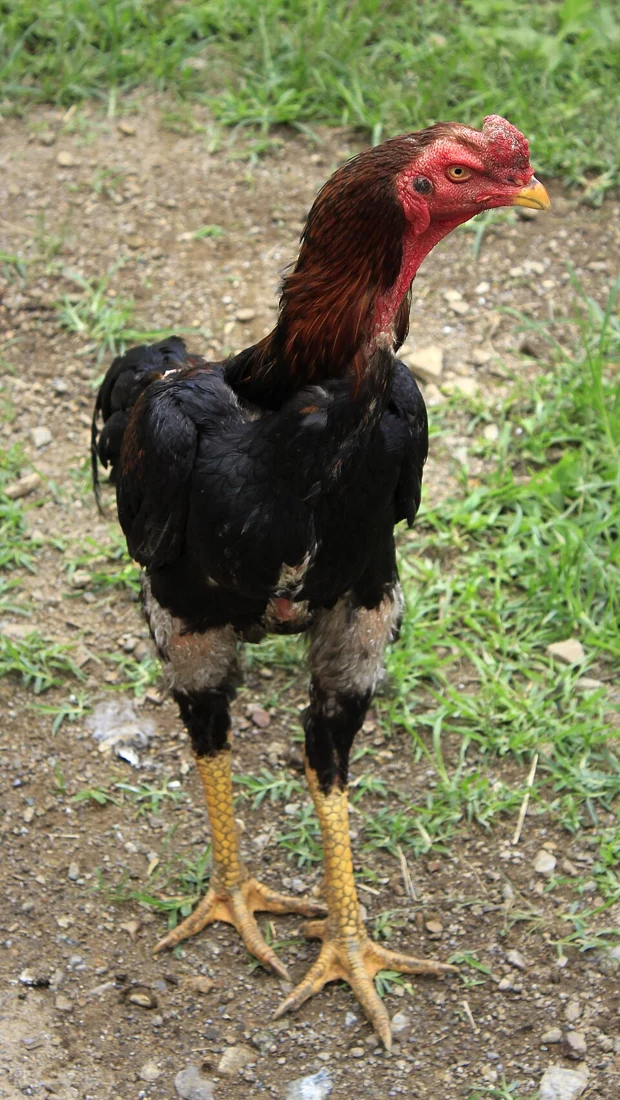
An upright Japanese breed with hard feathering and strong regional types. Impressive stature needs to be matched with practical housing and careful separation.
Egg color
Tinted to light brown
Annual eggs
About 90
Adult size
U.S. reference: hen 7 lb; rooster 11 lb
Broodiness
Can be devoted mothers; large hens may damage eggs
Have Shamo in your flock?Your everyday experience could help someone choose their next chickens.
U.S. conservation population, 2026 list. This is not a worldwide extinction-risk rating.
Japanese development with important type distinctions
Shamo developed in Japan from ancestry associated with Thailand, with historical accounts placing that introduction in the early Edo period. Its game-bird history explains some selection priorities, but present-day conservation keeping should focus on identifiable, sound birds and safe flock management.
American recognition dates to 1981 for Black, Dark and Black Breasted Red. Names within Japanese poultry classification require care. O-Shamo and Chu-Shamo are meaningful size contexts; Ko Shamo needs its own identity review rather than being treated here as an automatic miniature of this large-fowl entry.
The familiar silhouette is upright and muscular, with close hard feathering and relatively sparse coverage in places. References describe a pea comb, very small wattles, clean yellow shanks and light or pearl-toned eyes. Compare body structure, movement and head details instead of identifying a bird solely because it stands tall.
The U.S. adult reference is 11 pounds for a male and 7 pounds for a female. Other accounts distinguish O-Shamo and Chu-Shamo weights. Do not combine those figures into a universal Shamo range or use them to judge Ko Shamo. This page’s photograph illustrates a photographer-identified Shamo; it does not certify a show standard or pedigree.
The Conservancy’s regional examples give O-Shamo males 12.4 pounds and females 7.5 pounds, and Chu-Shamo males 8 pounds and females 6 pounds. It separately describes Kimpa Shamo at 4 pounds for males and 3 pounds for females, with hen-feathered males. These named contexts explain the size differences; they are not alternative targets for an unidentified bird or synonyms for Ko Shamo.
The Conservancy gives about 90 medium/large pale-brown eggs per year; OSU describes fair-to-poor production. Hens can mother chicks, but their size can damage eggs. A roomy protected nest and a management plan are more relevant than expecting a large bird to incubate a large clutch automatically.
Shamo growth and breeding decisions depend on the type being kept. The cited references do not establish one first-lay week across those contexts. A keeper should record age, weight and development rather than borrowing a timetable from a heavy meat hybrid.
Young birds can become aggressive early, so prepare accommodation that can change as they develop. Photograph consistent side views and record sound movement as well as height. An imposing adult is not a reason to overlook awkward access or a youngster losing access to resources. The flock’s development record should include management changes and their outcomes, not only the most impressive photographs.
Shamo may be personable with handlers while aggressive toward same-sex chickens. That combination makes the separation plan essential. Observe females’ interactions too; the concern is not confined to mature roosters. A bird that willingly approaches you can still be unsuitable for a shared flock pen.
Have secure separate spaces ready before introducing birds or raising chicks. Build a daily routine that another caregiver can follow without guessing which birds may be mixed. Evaluate the individuals repeatedly as they mature. Good human handling does not replace supervision of chicken-to-chicken interactions, and an adult’s calm moment is not proof of compatibility after a housing change.
Check clearance at entrances, resting areas and ordinary routes. Floor area alone does not tell you whether a tall bird can use a coop comfortably. Arrange spaces so inspection and separation remain straightforward, without forcing a heavy bird through an awkward opening.
Protect sparse feather coverage from exposure, and provide ordinary shade, water and dry shelter. Limited flying tendencies in a breed account do not make an open pen predator-safe or every individual unable to cross a fence. Choose secure boundaries on the basis of the whole keeping situation. The enclosure must work while you are away, not only when a keeper is standing beside it.
Large mothers do not automatically need large clutches
The Conservancy gives about 90 medium-to-large pale eggs annually, while Oklahoma State describes fair-to-poor laying. Hens can be devoted mothers, but their size can damage eggs. Plan a roomy protected nest and observe the actual hen’s sitting rather than assuming that a heavy bird should cover an unusually large clutch.
Keep type, parent identity, fertility, hatch results and soundness together in the breeding record. Do not use the Shamo name for undocumented crosses based on carriage alone. The 2026 U.S. Critical assessment gives conservation context, but preserving a population requires more than retaining the tallest birds or buying an unusual photograph’s lookalike.
A specialist conservation flock, not an easy layer flock
Shamo is a serious option for an experienced keeper with suitable accommodation and a deliberate preservation goal. It is generally a poor fit for someone seeking an uncomplicated mixed flock, maximum eggs or a large beginner-friendly pet based on appearance alone.
Compare Malay and Aseel for other hard-feathered conservation projects while retaining their separate identities. Discuss the specific Shamo type before sizing the housing. The important purchase information includes a documented name, size context and breeding history. Those details are more useful than a seller’s promise that every tall bird is the same magnificent giant.
Keep males apart and supervise females' introductions. Scale entrances, nests and handling to the actual type, and preserve its identity instead of treating every chicken called Shamo as the same size.
These priorities apply the breed traits above to a backyard setup. Use the chick-to-coop planner for young birds and the housing guides for your coop plan.
Questions keepers ask
Is Ko Shamo just a small bird covered by these weights?
No. It needs a separate identity and standard review. This entry does not treat Ko Shamo as an alias for the large-fowl Shamo profile. [1][3]
Can a friendly Shamo live safely with any chicken?
No. Human sociability and aggression toward other chickens are separate traits. Keep secure separation available and observe both sexes. [1][2]
Does a large hen guarantee successful natural incubation?
No. Large hens may damage eggs. Nest design, clutch management and the individual hen’s behavior need observation. [1][2]
Are all Shamo types the same adult weight?
No. U.S. standard references and named Japanese type contexts differ. Match the weight reference to the actual type and sex. [1][2][3]
Reviewed October 8, 2026. Breed organizations, university references and conservation histories establish breed traits; hatchery estimates describe named supplier lines. This profile identifies the source of the figures instead of treating them as one standardized trial.
Our care recommendations and suggested records apply those traits and Extension husbandry guidance to a backyard flock. They are editorial advice, not results from a controlled breed trial. A breed reputation does not establish an individual bird's behavior, health or readiness to move outdoors.
Egg-size words are source descriptions, not measured carton grades. Adult weights refer to mature birds, not market or pullet weights. Conservation categories describe U.S. populations. Examples of varieties are not a complete list of every national registry's accepted colors.