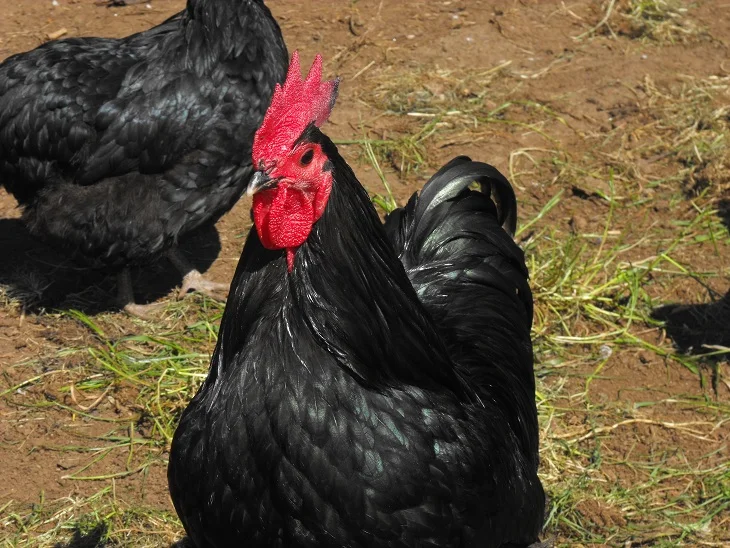
Australorp developed from imported Black Orpington stock in Australia, with selection emphasizing useful egg production. That emphasis took it in a different direction from the increasingly show-oriented Orpington. Its name reflects the Australian Orpington background, but the modern breeds are distinct.
Historical laying competitions made Australorps famous. Record-breaking individual hens demonstrate what selected birds achieved under particular conditions; those totals are not sensible guarantees for an ordinary backyard flock. Use current flock or named-line figures when planning how many hens you need.
The familiar black Australorp has a green sheen, close-fitting plumage, a red single comb and dark shanks with pale soles. Sheen is a reflected-light effect, not a separate green variety. Its more streamlined feathering is a useful contrast with the abundant fluff of an exhibition Orpington.
Color recognition varies across countries and registries. A blue or white bird offered as an Australorp needs the appropriate standard context rather than an assumption that every marketed color has identical status. Large-fowl weights in the grid should not be applied to bantams.
The 250–280 figure describes Cackle's Black Australorp line. The Conservancy also describes good sitting and mothering, so broodiness should be considered alongside the attraction of a productive layer.
For a laying flock, distinguish age at the first egg from performance through a full season. The cited Black Australorp line's annual range is an estimate for that source, rather than a breed-wide trial or a fixed first-lay age.
Our suggested record starts with hatch date and first egg, then notes a monthly count and any periods of sitting or molt. That makes it possible to see why a hen's real year differs from an advertised range without expecting an egg on every calendar day.
Australorps are commonly described as friendly and manageable, which helps explain their appeal in family flocks. Gentle does not mean motionless: they still benefit from space to investigate and forage. Individual behavior and the way young birds are handled matter.
Our recommendation for a mixed flock is to compare temperament as well as adult size. Watch whether a quiet hen keeps access to resources when more forceful birds are present. Calm breed tendencies are useful for shortlisting, but do not justify leaving children alone with an unfamiliar rooster.
A substantial, dark-feathered bird needs reliable shade in summer. Plan shade that remains usable through the hottest part of the afternoon and place water where the flock actually rests. Ventilation should move air through occupied space rather than merely make the empty roof look open.
Our practical recommendation is to offer an activity area alongside the coop, particularly when birds spend long periods confined. In winter, inspect the single comb and manage damp litter. A bird can be adaptable to your climate while still depending on a well-designed shelter every day.
Australorp's working history makes laying performance an important breeding goal, alongside correct body type and color. Our suggested records include the hen's first two laying seasons, hatch results and mature condition, rather than a single unusually productive week.
Broodiness can still occur even though earlier selection emphasized laying. Decide whether natural hatching is a goal before selecting replacements. Retaining birds only for the biggest, fluffiest appearance can move a flock away from the qualities that originally distinguished Australorp from Orpington.
Australorp is worth considering for a keeper seeking brown eggs, a manageable temperament and a substantial heritage bird. Compare Orpington if broodiness and abundant feathering appeal, and Plymouth Rock for another established dual-purpose option. Give summer shade serious weight in a hot yard. The right choice is the bird whose behavior and care needs fit the space you actually have.
Useful for a flock that values both eggs and manageable behavior. Historic contest records describe exceptional birds, not a realistic promise for every backyard hen.
These priorities apply the breed traits above to a backyard setup. Use the chick-to-coop planner for young birds and the housing guides for your coop plan.
Questions keepers ask
Will my Australorp lay a world-record number of eggs?
Probably not. Historical records belong to selected individuals and test conditions. The named-line estimate and your own seasonal records provide a better planning basis than treating a famous record as the normal output of every hen. [1][3]
Is Australorp simply another name for Orpington?
No. It developed from Orpington ancestry, but Australian selection for laying created a distinct breed. Compare body and feathering, production goals and the applicable standard rather than relying on the shared history alone. [1][4]
Can Australorps go broody?
Yes. Broodiness varies across birds and strains. If you want dependable natural hatching, track which hens actually sit consistently; if you want table eggs, include their sitting periods when evaluating annual laying performance. [1]
Are black feathers a reason to avoid a hot climate?
They are a reason to plan ample shade and monitor comfort. Heat management also depends on airflow, water, humidity and the individual bird. Choose the breed with the shelter plan, rather than expecting plumage color alone to determine the outcome. [1][6]
Reviewed October 7, 2026. Breed organizations, university references and conservation histories establish breed traits; hatchery estimates describe named supplier lines. This profile identifies the source of the figures instead of treating them as one standardized trial.
Our care recommendations and suggested records apply those traits and Extension husbandry guidance to a backyard flock. They are editorial advice, not results from a controlled breed trial. A breed reputation does not establish an individual bird's behavior, health or readiness to move outdoors.
Egg-size words are source descriptions, not measured carton grades. Adult weights refer to mature birds, not market or pullet weights. Conservation categories describe U.S. populations. Examples of varieties are not a complete list of every national registry's accepted colors.