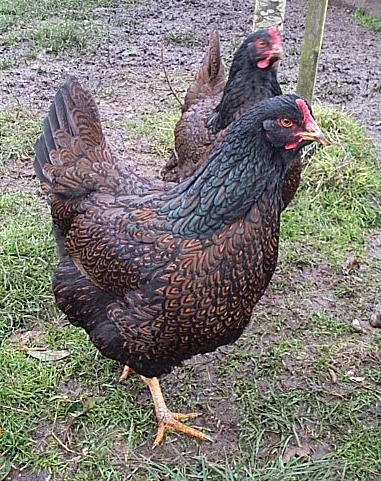
Barnevelder takes its name from Barneveld in the Netherlands. Brown eggs were a major attraction when the breed entered British poultry keeping in the early twentieth century. Early birds had several feather patterns before double lacing became the familiar exhibition image.
That development matters when comparing current flocks. A bird selected for exquisite double-laced plumage and a supplier line selected for dependable production need not perform identically. The breed name brings together a history of utility and exhibition, rather than one uniform modern laying strain.
On the familiar double-laced hen, dark bands follow the feather's outline and create a repeating layered pattern. Roosters have a different plumage presentation, so a male that does not resemble the hen's lacing is not automatically incorrect. A single comb and clean legs are useful additional identifiers.
The university reference and the hatchery example do not give identical adult weights. The fact grid identifies the standard-size reference instead of averaging different descriptions. When comparing a smaller bird, establish its variety and size form before treating weight alone as evidence of poor breed type.
Cackle estimates 150–200 eggs for its line and labels that line a non-sitter. Oklahoma State describes the breed as having sitting and mothering ability. These references support variation between populations, not one universal broody label.
The cited sources do not justify a precise first-egg week for every Barnevelder line. A useful pullet record keeps age, season, first egg and later egg size separate. Adult feather quality also needs time to evaluate; an early photograph is not the entire breeding assessment.
Our recommendation is to compare hatchmates raised in similar conditions. That gives a fairer view of development than comparing a spring-hatched pullet with an older autumn purchase whose hatch date and previous feeding history are unknown.
Barnevelders are often chosen as approachable backyard birds, but a breed tendency should be checked against the actual source flock. Watch a bird move normally, approach the feeder and respond to people rather than judging friendliness from a posed photograph.
Our practical suggestion is to build a quiet routine and offer enough run space to explore without forcing close contact. In a mixed flock, compare adult size and confidence as well as egg color. A calm-looking hen still needs a way to leave an uncomfortable encounter.
Clean legs simplify some wet-weather management compared with heavily feather-footed breeds, but they do not make mud a suitable living surface. Our recommended setup includes a well-drained entrance, a dry resting area and sheltered daytime space for periods of rain.
Inspect the single comb during freezing weather and make summer shade part of the same plan. A useful coop check is to look at the space birds use when all are indoors: roost access, water access and air quality matter most when bad weather compresses the flock into the shelter.
Select for overall type before treating a beautifully laced feather as the whole bird. Our suggested records combine adult photographs, weight, eggs across a defined season and actual sitting behavior. This is especially useful because the university's historical description and the supplier line differ on broodiness.
Preserve the identity of each mating group and avoid reporting one flock's best hen as a breed average. If dark shell color is a goal, record ordinary eggs through the laying cycle, not just the darkest egg used in a sale photograph.
Barnevelder suits someone who enjoys patterned plumage and wants a brown-egg flock with a documented source. Compare Wyandotte for another laced option, Welsummer for a different Dutch brown-egg breed, and Marans if dark shell selection is central. Choose a particular line's behavior and performance over the most dramatic egg or feather photograph in an advertisement.
Choose this for patterned feathers and brown eggs together. Provide winter comb protection and verify whether the selected line prioritizes egg shade, exhibition lacing, or laying output.
These priorities apply the breed traits above to a backyard setup. Use the chick-to-coop planner for young birds and the housing guides for your coop plan.
Questions keepers ask
Do Barnevelders always lay very dark eggs?
No uniform shell shade is guaranteed by the name. Compare eggs from the particular flock over a laying cycle. A photograph of one exceptional egg is less informative than dated examples of the usual output. [1][2]
Will they become broody?
References and supplier descriptions differ. Some historical accounts describe sitting birds, while a current named line is described as less inclined to sit. Treat broodiness as a flock and individual trait rather than a universal yes or no. [1][2]
Why do the rooster and hen patterns look different?
Male and female plumage presentation differs in the familiar variety. Compare each sex with the appropriate standard description. Matching the hen's feather pattern is not the sole way to identify a correct rooster. [1][2]
Why are two references giving different weights?
A breed standard, a named supplier line and different size forms may describe different birds. The fact grid identifies its weight basis. Keep mature hen and rooster weights separate from juvenile or processing weights when comparing your flock. [1][2]
Reviewed October 7, 2026. Breed organizations, university references and conservation histories establish breed traits; hatchery estimates describe named supplier lines. This profile identifies the source of the figures instead of treating them as one standardized trial.
Our care recommendations and suggested records apply those traits and Extension husbandry guidance to a backyard flock. They are editorial advice, not results from a controlled breed trial. A breed reputation does not establish an individual bird's behavior, health or readiness to move outdoors.
Egg-size words are source descriptions, not measured carton grades. Adult weights refer to mature birds, not market or pullet weights. Conservation categories describe U.S. populations. Examples of varieties are not a complete list of every national registry's accepted colors.