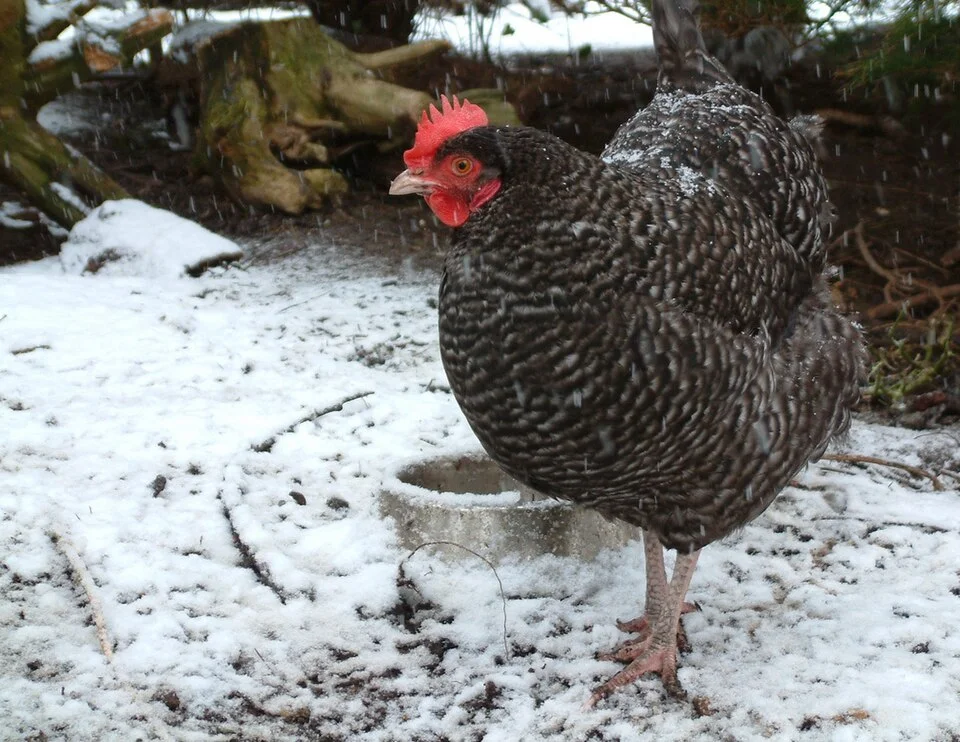
Marans takes its name from a town near France's Atlantic coast. Its history combines local farm poultry with imported birds, and dark eggs became a defining selection goal. The breed later reached Britain, where clean-legged birds developed alongside the feather-legged French tradition. This explains why two apparently different birds may both be sold under the same breed name. For an exhibition or breeding project, specify the national standard and variety; for an egg flock, distinguish that identity from actual laying performance.
Copper, cuckoo, wheaten—and the feathered-leg distinction
French-standard Marans have a single comb, four toes, a strong body and modest feathering on the shanks and outer toes. Black Copper is one variety, not the whole breed. Cuckoo, Wheaten, White and other varieties have their own plumage requirements. The French club publishes separate large-fowl and bantam weights. The weight example in our facts describes Cackle's French Black Copper large fowl, so it should not be used to judge a bantam or replace a show's standard.
The numerical example is Cackle's French Black Copper line, not all Marans varieties. Dark-brown eggs are a selection goal, while shade can change during a laying cycle. A photograph of the darkest egg is not a flock average.
A Marans pullet's first eggs need not show her mature egg size or typical shell shade. The French club describes changes within the laying cycle, including lighter shells later in a sustained run. Our suggested record is a dated series from each identified hen, photographed in the same light, with egg weights and breaks in laying noted. This lets you compare her development over time without turning one early egg, one unusually dark egg or a heavily edited photograph into a lifetime prediction.
The cited French Black Copper line is described as docile and inclined to sit. That makes Marans a reasonable candidate for a hands-on backyard flock, but it does not establish the behavior of every variety or rooster. In a mixed flock, check whether smaller hens can reach feed and whether a broody bird is monopolizing a nest. Our recommendation is to provide an alternative nest and multiple feeding positions before interpreting a quiet hen's missing eggs as poor productivity.
Plan the coop for an adult large-fowl bird, including a doorway and nest she can use without squeezing past flockmates. Feathered feet make dry bedding and a firm route to the run particularly useful; inspect toes after muddy or freezing weather. A single comb still needs frost protection through dry, ventilated shelter. In summer, give the flock shade and accessible water. A covered area outside the coop helps preserve movement space when rain would otherwise turn the entrance into a muddy bottleneck.
The French club's nine-point shell-color scale is a reference for its breeding standard, not a promise that every egg will reach the darkest scores. Record several eggs across a hen's cycle while also evaluating body type, health, fertility and laying persistence. Do not choose breeding stock solely from the darkest photograph in a listing. Our suggested breeding ledger links each hen's egg records to her family and hatch results. It makes compromises visible when improving shell shade appears to reduce another trait you value.
Marans makes sense when dark brown eggs are part of the pleasure of keeping chickens and you are willing to evaluate a named line. It is less straightforward if your priority is the cheapest possible dozen or identical shell color every day. Compare a sequence of eggs, the birds' standard and the actual production record. Welsummer and Barnevelder are useful comparisons, but none of these names alone guarantees the deepest shade. Choose the flock you can house well rather than a carton photograph.
Choose the standard and variety before judging the bird. Dark shell pigmentation can change over the laying cycle, so a single exceptionally dark egg is a poor summary of a whole flock.
These priorities apply the breed traits above to a backyard setup. Use the chick-to-coop planner for young birds and the housing guides for your coop plan.
Questions keepers ask
Will every Marans egg be chocolate brown?
No. Shade differs between hens and changes through a laying cycle. The French club's color scale describes a selection target. A dated series of eggs is more informative than the darkest egg a seller has saved for a photograph. [5][9]
Are clean-legged Marans always crosses?
No. British development includes clean-legged birds, while the French standard calls for leg feathering. Establish which standard the flock follows before deciding whether a bird fits it. Egg color alone cannot establish breed identity. [1][4]
Is Black Copper a separate breed?
Black Copper is a Marans variety. Other varieties differ in plumage, and their production need not match the Black Copper hatchery line used in this profile's numerical example. Breed, variety and source line are three different pieces of information. [4]
How should I compare egg-color photographs?
Use the same lighting and background, include several eggs and identify the laying stage. Keep original photographs. Filters, unusual lighting and a single first egg can make comparisons misleading even when the seller has accurately named the birds. [5][9]
Reviewed October 7, 2026. Breed organizations, university references and conservation histories establish breed traits; hatchery estimates describe named supplier lines. This profile identifies the source of the figures instead of treating them as one standardized trial.
Our care recommendations and suggested records apply those traits and Extension husbandry guidance to a backyard flock. They are editorial advice, not results from a controlled breed trial. A breed reputation does not establish an individual bird's behavior, health or readiness to move outdoors.
Egg-size words are source descriptions, not measured carton grades. Adult weights refer to mature birds, not market or pullet weights. Conservation categories describe U.S. populations. Examples of varieties are not a complete list of every national registry's accepted colors.