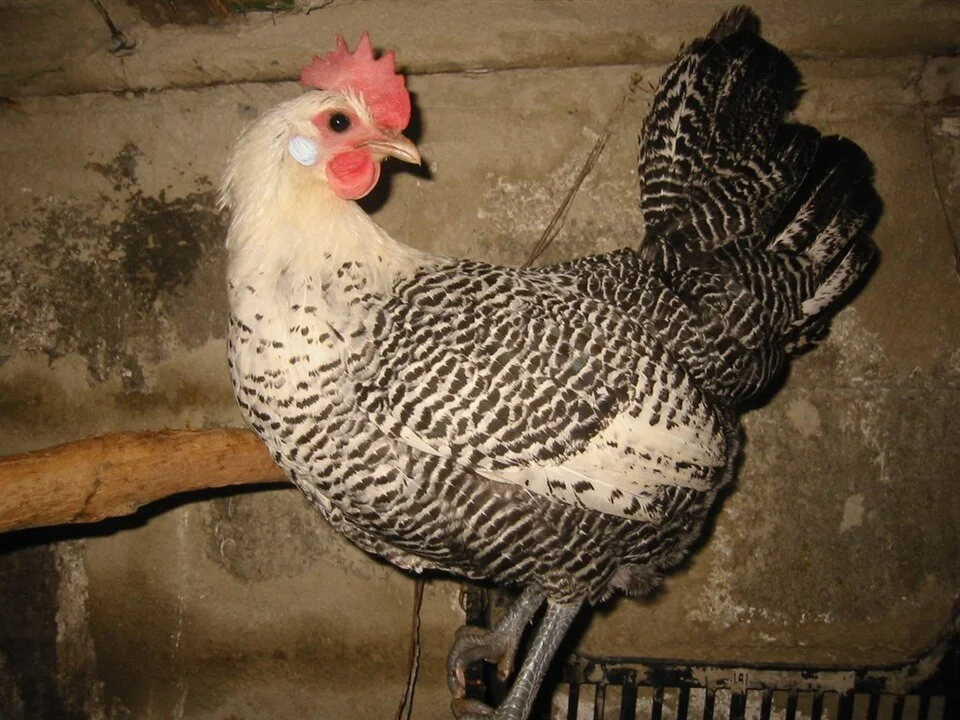
Campine and the related Braekel share a Belgian background, but Campine became a distinct, smaller laying bird. British breeders helped establish its later exhibition type, including the unusual hen-feathered male. Silver and golden varieties carry the same characteristic pattern in different ground colors.
The useful modern comparison is a light, active white-egg bird rather than a heavy dual-purpose chicken. Its long history does not establish every old origin story as fact; breed identity is better grounded in the documented type and breeding development.
The head and neck have the variety's ground color, while the body has contrasting dark markings. The large single comb, white earlobes and dark clean shanks are additional identifiers. Campine males have hen-like feathering rather than the usual long pointed male saddle feathers.
That feature is useful to understand before sexing an adolescent bird by adult feather shape. The golden and silver varieties also have a particular cross-sexing application; keeping one variety pure is a different breeding goal from deliberately making that cross.
A light, active white-egg layer with little inclination to brood. Its annual reference range is modest beside modern commercial layers; patterned plumage and lively ranging behavior are part of its appeal.
Campine belongs to the active laying-breed group, but the references here do not provide one universal first-egg week. Our recommended record includes hatch date, development of the adult pattern and first laying, instead of inferring maturity from liveliness alone.
A busy young bird may look capable while still needing juvenile care. For breeding comparisons, use birds of the same age and note the variety. The annual egg reference applies to mature laying performance and should not be used as a juvenile development chart.
Campines are inquisitive, quick and often entertaining. They may become familiar with people while remaining reluctant to be held. That combination can delight an observant keeper and frustrate someone whose first goal is a lap chicken.
Our suggestion is to develop a dependable feeding cue and a calm catch-up routine. It is easier to inspect an active bird that knows the routine than to improvise a chase. In mixed groups, watch whether smaller Campines lose feeder access to heavier or more assertive chickens.
Campine is a ranging bird that can fly. Plan an enclosure with secure overhead containment and enough usable space for activity, rather than relying on a short perimeter fence. Give birds a sheltered route back into the coop so that a tree does not become the preferred bedtime location.
The exposed single comb and preference for warmer conditions make winter planning important. Our recommended checks include roost dryness, wind exposure, water access and the condition of the actual birds. Summer shade still belongs in the plan even for a breed suited to warmth.
The Conservancy describes a golden male crossed with silver females producing distinguishable day-old offspring. This is a particular directional mating, not a guarantee that every Campine chick can be sexed by color. Reversing the parents or mixing unidentified varieties changes the basis of the claim.
Keep the pure-variety breeding project and the cross clearly labeled. Our suggested records include parental variety, chick markings and later confirmed sex. Retain the breed's body and hen-feathered male type along with feather pattern; an attractive barred bird alone does not establish Campine identity.
Campine suits someone who wants white eggs, an active heritage flock and the pleasure of watching unusual feathering. It is less convenient in a small bare pen, a severely cold exposed yard or a flock dominated by much larger birds. Compare Hamburg and Ancona for similarly active options. Decide how you will contain and inspect them before choosing by pattern.
Expect movement and flight rather than a reliably sedentary pet. Secure containment is more useful than choosing a low fence based only on the bird's small body.
These priorities apply the breed traits above to a backyard setup. Use the chick-to-coop planner for young birds and the housing guides for your coop plan.
Questions keepers ask
Why does my male have hen-like feathers?
Hen-feathering is characteristic of the standardized Campine male. The absence of the usual pointed male feather presentation is therefore not enough to identify the bird as female. Use age, development and other observations together. [2]
Can every Campine chick be sexed by color?
No. The documented example is a specific golden-male by silver-female mating. A mixed or reversed pairing is not automatically equivalent. Record the parent varieties and confirm the chicks' sex as they develop. [1][6]
Are Campines usually broody?
They are generally non-broody laying birds. A planned hatch should have a separate incubation arrangement. Do not buy the breed expecting it to provide reliable surrogate mothers merely because it is an old farm breed. [1]
Can I keep them with large, gentle hens?
Possibly, but watch resource access as well as apparent friendliness. Size differences can affect feeders, roosts and space. Our recommendation is to retain a separation option if smaller birds are repeatedly displaced. [1]
Reviewed October 7, 2026. Breed organizations, university references and conservation histories establish breed traits; hatchery estimates describe named supplier lines. This profile identifies the source of the figures instead of treating them as one standardized trial.
Our care recommendations and suggested records apply those traits and Extension husbandry guidance to a backyard flock. They are editorial advice, not results from a controlled breed trial. A breed reputation does not establish an individual bird's behavior, health or readiness to move outdoors.
Egg-size words are source descriptions, not measured carton grades. Adult weights refer to mature birds, not market or pullet weights. Conservation categories describe U.S. populations. Examples of varieties are not a complete list of every national registry's accepted colors.