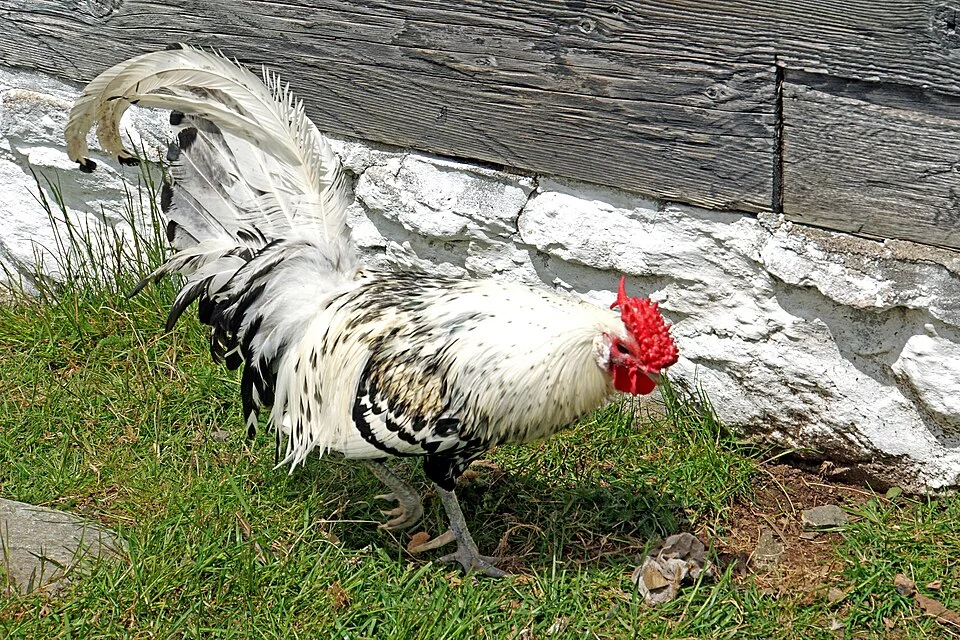
Hamburg brings together several northern European poultry traditions, with different varieties having their own development histories. British exhibition selection helped establish the familiar modern presentations. Its enduring role is as an active white-egg layer rather than a heavy table chicken.
The name does not imply that every variety arose from one identical original flock. That matters when comparing appearance and production. A Silver Spangled supplier line is a concrete example, not a substitute for the history or performance of every penciled, spangled or solid-colored Hamburg.
The rose comb, pale earlobes, clean dark shanks and light active outline are useful identifiers. Spangled varieties have dark markings at feather ends, while penciled varieties have a different repeated pattern. Golden and silver ground colors change the appearance further.
Mature males develop sweeping tails and normal male feathering. Our practical recommendation is to identify the variety before comparing photographs; a golden penciled bird should not be judged as a poorly marked Silver Spangled Hamburg. Adult size is also modest compared with many dual-purpose breeds.
The broad 120–225 range should be read alongside the breed's small body and comparatively small eggs. The Conservancy describes early laying and little broodiness, with active flight and ranging habits.
The Conservancy places pullet first laying around four to five months, with variation by bird and strain. Its annual range is broad, and the source emphasizes continued laying over several years. That is different from judging the breed only on the biggest first-year number.
Our suggested record includes first egg, eggs over a defined season and performance in later years. Youngsters still need careful rearing even if they mature comparatively early. A lively chick's speed is not proof that it is ready for adult housing or mixed-age flock competition.
Hamburgs are active, quick and often reluctant to be held. They can be delightful to watch but are not the most obvious choice for a child's first cuddly chicken. Alertness is useful behavior, not guaranteed escape from predators.
Our recommendation is to practice a familiar catch-up routine while birds are young and provide a secure area for inspection. Observe adult male behavior and flock noise as well as hen friendliness. A beautiful small bird can still be an inconvenient fit for a crowded, close-neighbor setting.
Plan reliable overhead containment and a sheltered bedtime route. Hamburgs may choose high roosts or hidden nesting places when allowed unrestricted access. Our suggested setup makes normal activity possible without making egg collection or evening retrieval a daily chase.
The rose comb changes winter exposure compared with a large single comb, but dry shelter and water remain essential. In summer, provide shade and airflow. Do not assume a small body requires only a tiny bare enclosure: usable movement space matters to a bird that spends much of its day investigating.
Select the correct variety pattern alongside the active laying-breed type. Our recommended record includes first laying, annual production, mature weight, parent group and later-year performance. This can reveal a useful long-term layer that would be missed by choosing on one photogenic feather or one exceptional week.
Hamburgs are generally non-sitters. A breeding project needs a separate incubation plan rather than waiting for the flock to provide its own broody mothers. Keep pure-variety matings identifiable and describe mixed offspring honestly when experimenting across varieties or breeds.
Hamburg suits someone who enjoys active heritage layers and has secure space and a handling routine. It is less convenient where cuddling, low noise or a minimal enclosure are the main goals. Compare Campine and Ancona for other lively laying options. Decide how you will retrieve, inspect and contain the birds before choosing the feather pattern that catches your eye.
A covered run suits a bird inclined to fly and seek high roosts. Select for active laying and ornamental interest rather than expecting every Hamburg to enjoy being carried.
These priorities apply the breed traits above to a backyard setup. Use the chick-to-coop planner for young birds and the housing guides for your coop plan.
Questions keepers ask
Are Hamburg eggs small because the hens are young?
The breed itself has a comparatively small egg description, while pullet eggs can differ further. Keep age and the mature flock's ordinary output separate. Do not apply a large dual-purpose breed's egg-size expectations automatically. [1]
Will they hatch their own chicks?
Hamburgs are generally non-broody. Arrange an incubator or appropriate sitter for a planned hatch. The occasional individual exception is not a dependable flock-level incubation plan. [1]
Does a rose comb mean Hamburg is a calm breed?
No. Comb form and temperament are different traits. Hamburg is characteristically active and alert. Choose by its behavior and enclosure needs rather than borrowing the temperament of another rose-combed breed. [1][2]
Can they be kept in a normal backyard run?
Yes, if the run supports activity and dependable containment. Our recommendation is to secure the overhead escape route and establish a catch-up routine. A short open-topped fence is a poor starting plan for capable flyers. [1]
Reviewed October 7, 2026. Breed organizations, university references and conservation histories establish breed traits; hatchery estimates describe named supplier lines. This profile identifies the source of the figures instead of treating them as one standardized trial.
Our care recommendations and suggested records apply those traits and Extension husbandry guidance to a backyard flock. They are editorial advice, not results from a controlled breed trial. A breed reputation does not establish an individual bird's behavior, health or readiness to move outdoors.
Egg-size words are source descriptions, not measured carton grades. Adult weights refer to mature birds, not market or pullet weights. Conservation categories describe U.S. populations. Examples of varieties are not a complete list of every national registry's accepted colors.