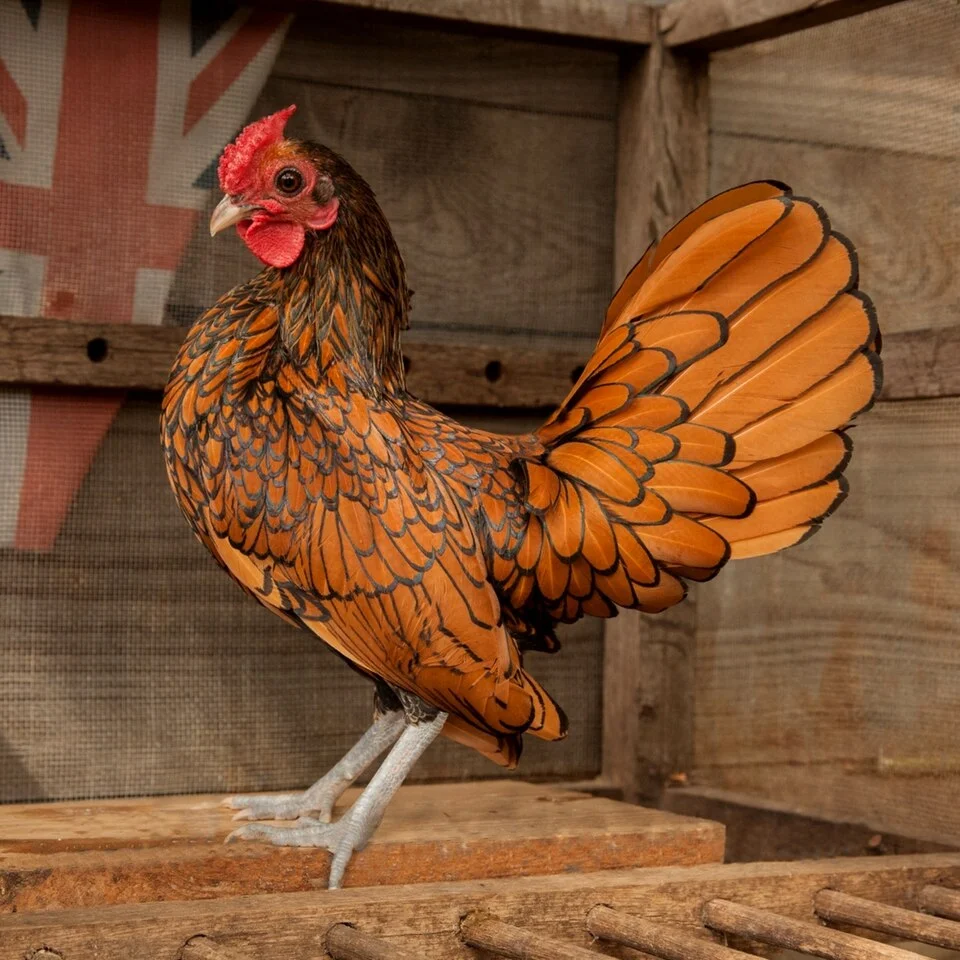
Sir John Sebright developed this British bantam in the early nineteenth century with finely defined lacing as a central goal. Its exact founding recipe is not fully documented. Sebright is a true bantam, with no standard large-fowl counterpart, and influenced the development of other laced poultry. The ornamental history explains its appeal and limitations today. It should be chosen as a small, distinctive bird and a potentially demanding breeding project, rather than judged as a miniature replacement for a prolific farm layer.
Golden and Silver Sebrights have sharply edged feathers on a compact body, a rose comb and clean slate-colored legs. Males are hen-feathered: they lack the conventional pointed male plumage and long sickle-feather appearance of many other breeds. That feature is part of breed identity, not evidence that a mature male is actually a hen. The adult weight reference is in ounces. A larger laced chicken is not a giant Sebright; other laced breeds have their own size, structure and plumage requirements.
The reference gives only 60–80 tiny eggs and warns of limited fertility in some lines. Hens generally do not sit. A breeding project needs an incubation plan rather than a promise of prolific eggs or reliable mothers.
Small size makes observation and equipment fit important
Raising a tiny ornamental bird still requires a balanced age-appropriate ration and attentive development checks. Our suggested record follows hatch date, weight where practical, feather development and first lay. Provide food and water arrangements the youngsters can use safely, and watch competition if they share space with bigger chicks. Do not expect adult-looking lacing to establish full maturity or a guaranteed first-egg week. Their eventual eggs remain bantam-sized, so performance should be evaluated within the breed's scale rather than against large-fowl egg cartons.
Sebrights can become familiar with people while remaining active birds rather than reliable lap chickens. Their flight ability makes both enclosure design and catching arrangements important. Our recommendation is to build a predictable feeding routine in a secure space and keep an accessible inspection area. A friendly approach for treats does not guarantee easy capture in a tree at dusk. In a mixed flock, watch whether a small bird can leave an encounter and return to food, rather than assuming a lively personality compensates for size.
A covered run helps with flight and small-body safety
Check gaps, mesh and door edges for a bantam-sized bird. A covered run offers useful containment and predator protection, with room for movement and suitable perching. Provide dry shelter from cold, damp weather and reliable summer shade and water. Our practical recommendation is to inspect boundaries from both directions: where a small bird could leave and where a predator could enter. Keep enough usable space that birds are not trapped together at one feeder or perch. Tiny adult weights do not justify a cramped ornamental cage.
The reference describes low sitting tendency and fertility differences between families. A breeding plan therefore needs an incubator or suitable surrogate hen, plus records distinguishing eggs laid, eggs set, fertility observations and successful hatches. Poor hatch percentage does not by itself identify whether the problem arose before or during incubation. Our recommendation is to retain parent and batch information while selecting sound birds with the desired lacing and hen feathering. Do not let precise feather edges become the only goal when maintaining a healthy, reproducing family.
A small ornamental project with realistic expectations
Sebright suits someone who enjoys fine lacing, lively bantams and the detail of exhibition or preservation breeding. It is less convenient if abundant eggs, dependable broody hens or easy unrestricted ranging are priorities. Compare Nankin if natural hatching matters more, or Hamburg for a larger active bird with ornamental patterning. Expect modest egg volume and make room for an incubation plan before ordering hatching eggs. The breed's beauty is a good reason to appreciate it, but does not remove its practical management demands.
A specialist ornamental choice. Limited eggs, fertility differences and weak broody tendencies should be part of a breeding plan before buying hatching eggs.
These priorities apply the breed traits above to a backyard setup. Use the chick-to-coop planner for young birds and the housing guides for your coop plan.
Questions keepers ask
Is there a large-fowl Sebright?
Sebright is a true bantam with no standard large-fowl counterpart. Larger laced chickens belong to other breeds or crosses. Evaluate a Sebright with its own bantam weight and structure rather than scaling up a photograph. [1][3]
Why does a Sebright rooster have hen-like feathers?
Hen feathering is a characteristic of the breed. It changes the usual male feather appearance, so absence of long sickles does not establish sex. Mature behavior, other physical features and reliable records help identify the individual. [1][2]
Will its hens raise the chicks?
They generally have low sitting tendency. Arrange incubation or a suitable broody hen in advance. Record fertility and hatch outcomes separately, especially because the reference describes differences between families rather than one uniform breeding result. [1]
Are Sebrights easy to contain because they are small?
Small size does not prevent flight. A secure covered run and careful gap checks are useful. Plan an accessible roosting and handling arrangement rather than relying on a low fence or expecting a friendly bird to return when called. [1][5]
Reviewed October 7, 2026. Breed organizations, university references and conservation histories establish breed traits; hatchery estimates describe named supplier lines. This profile identifies the source of the figures instead of treating them as one standardized trial.
Our care recommendations and suggested records apply those traits and Extension husbandry guidance to a backyard flock. They are editorial advice, not results from a controlled breed trial. A breed reputation does not establish an individual bird's behavior, health or readiness to move outdoors.
Egg-size words are source descriptions, not measured carton grades. Adult weights refer to mature birds, not market or pullet weights. Conservation categories describe U.S. populations. Examples of varieties are not a complete list of every national registry's accepted colors.