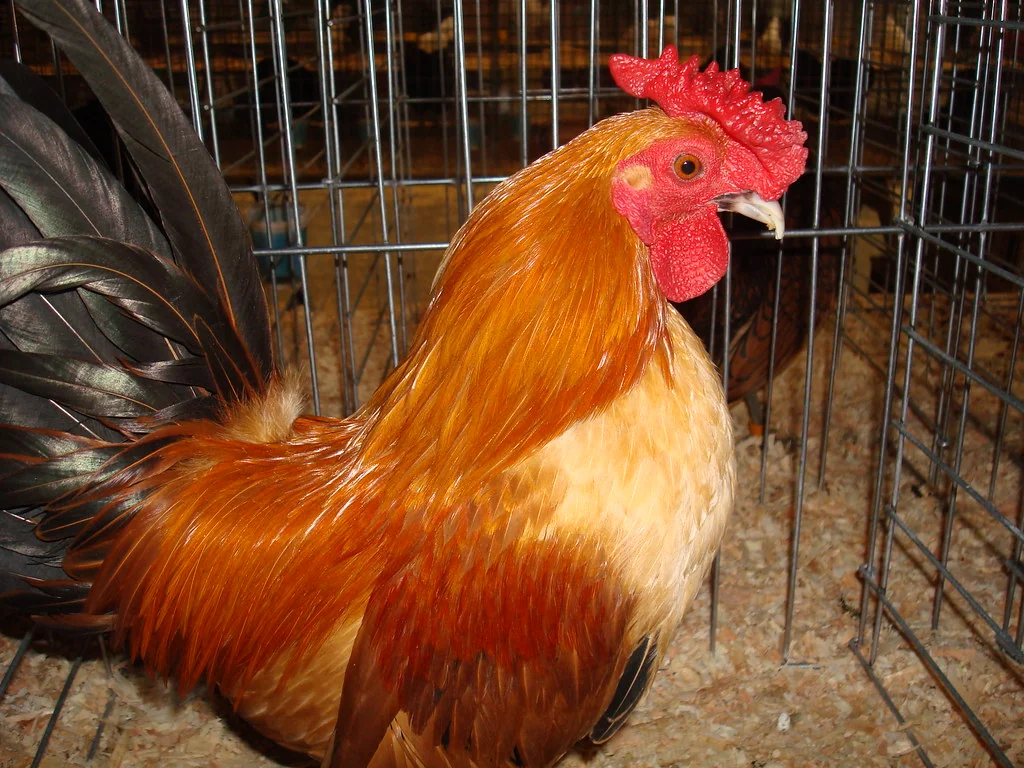
Nankin is a true bantam: it was not created simply by reducing a large breed. Its earliest origins remain uncertain. Long established in Britain, it contributed to other bantams and served a practical role hatching game-bird eggs. That history is useful when choosing one today. The small body and modest egg volume are not shortcomings to be corrected into a commercial layer; reliable sitting and an approachable character are central reasons people maintain the breed.
Nankins have warm chestnut coloring, with darker males and black in the tail. Single- and rose-combed forms share the breed name. Look beyond the color to clean legs, slate-toned shanks and a genuinely small adult body. Both sexes weigh well under two pounds in the cited reference. A bantam-sized cross with similar buff plumage is not automatically a Nankin. For a preservation or exhibition flock, document the family and comb form as carefully as the attractive coloring.
The Conservancy gives 80–100 small eggs and a first-lay example around 24 weeks. Its exceptional sitting ability is often more valuable than its egg volume. Keep feeding competition with much larger birds in mind.
The Conservancy gives roughly 24 weeks as a first-lay example, rather than a deadline for every pullet. Our practical recommendation is to track hatch date, first egg and growth while checking that chicks can reach suitable feed and water safely. Small size makes equipment fit important even when youngsters appear lively. Adult hens produce small eggs, so assess consistency and development within the bantam's own scale. Comparing a Nankin pullet's first eggs with a large-fowl carton is not a useful performance test.
Nankins are described as calm and inclined to stay together. Hens have a strong sitting reputation, which can be valuable in a natural-hatching flock. Our recommendation is to give a broody hen a quiet arrangement where she can leave the nest for food and water and return without disruption. Their small size also makes competition with heavy birds worth observing. Grouping together does not ensure that every bird gets a fair share at a crowded feeder or survives exposure to predators.
Small birds, secure boundaries and suitable roosts
Build for the birds' actual dimensions: check mesh openings, door gaps and access to feeders. A covered run offers useful protection, particularly for a small flock kept near larger chickens. Nankins can fly and seek elevated roosts, so do not assume bantam means ground-dwelling. Provide safe landing space and an arrangement you can inspect and clean. Single-combed birds need particular attention in freezing conditions; a sheltered, dry environment remains necessary for the rose-combed form too. Small housing should still offer movement and separation.
Nankin breeding can combine preservation with natural hatching, but neither should be left to chance. Maintain parent identities and comb-form records; track eggs set, hatch results and chick survival. The Conservancy notes that unusually round bantam eggs can complicate artificial incubation. Our recommendation is to record the method and outcomes rather than invent a special temperature from egg shape alone. Select healthy, structurally sound birds and retain more than a single favorite pair if your aim is to sustain a breeding population.
For companionship and broodiness, with modest egg expectations
Nankin suits a keeper who values a small, personable flock and may want hens to hatch eggs. It is a less direct fit for a large breakfast supply or a rough mixed flock dominated by heavy, assertive birds. Compare Sebright if ornament and activity matter more than broodiness, or Silkie if you are exploring other sitting breeds. Preservation adds a reason to keep careful family records, but good housing and compatibility still determine whether these little birds thrive with you.
Protect these small birds from rough companions and predators. Useful mothering does not mean large egg output; the small eggs are part of the breed's appeal and limitations.
These priorities apply the breed traits above to a backyard setup. Use the chick-to-coop planner for young birds and the housing guides for your coop plan.
Questions keepers ask
Is there a large-fowl Nankin?
No standard large-fowl counterpart defines the breed. Nankin is a true bantam. Small size is part of its identity, so weights and eggs should be compared with bantam references rather than scaled-up farm breeds. [1][2]
Can I keep Nankins with large hens?
Sometimes, with careful introductions and close observation. Provide feeding access and escape space suited to small birds. If a Nankin is repeatedly displaced, injured or unable to eat comfortably, separate compatible groups rather than waiting for size differences to resolve themselves. [1][5]
Does strong broodiness mean year-round eggs?
No. Sitting and raising chicks interrupt laying. Choose the breed because its mothering can be useful, and plan egg supply around those breaks. A broody hen's contribution may be chicks rather than another week's carton of eggs. [1][4]
Do tiny chickens need only a low fence?
No. Nankins can fly and seek high roosts. Check enclosure security and landing room, and use a covered run where appropriate. Small body size makes gaps more important; it does not eliminate flight or predator risk. [1][5]
Reviewed October 7, 2026. Breed organizations, university references and conservation histories establish breed traits; hatchery estimates describe named supplier lines. This profile identifies the source of the figures instead of treating them as one standardized trial.
Our care recommendations and suggested records apply those traits and Extension husbandry guidance to a backyard flock. They are editorial advice, not results from a controlled breed trial. A breed reputation does not establish an individual bird's behavior, health or readiness to move outdoors.
Egg-size words are source descriptions, not measured carton grades. Adult weights refer to mature birds, not market or pullet weights. Conservation categories describe U.S. populations. Examples of varieties are not a complete list of every national registry's accepted colors.