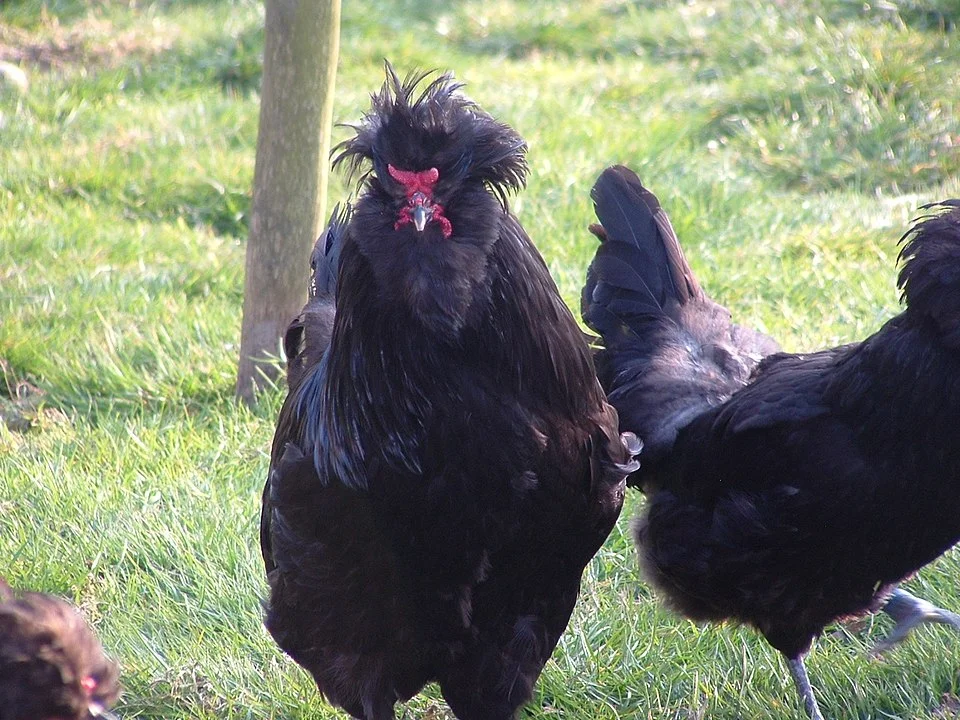
Crevecoeur takes its name from Normandy and belongs to the old French table-poultry tradition. Its exact early ancestry is less secure than the documented regional identity. It later became an exhibition and preservation bird, with black the familiar American presentation.
The crest is often the first feature a new keeper notices, but the breed's substantial body and table history matter too. Compare it as a distinct French breed rather than treating every black crested chicken as a Polish. Conservation involves retaining that identity along with increasing bird numbers.
The crest, beard and divided V-shaped comb create a striking head presentation. Crevecoeur has clean legs and four toes, unlike the five-toed Houdan. Its dark feathering and substantial body distinguish it from several lighter crested breeds.
A large crest can conceal details in a photograph, so observe the whole bird, including legs, toes and body shape. Our practical recommendation is to use the applicable standard for variety decisions rather than assume that every crested black cross has the required type.
The Conservancy gives 120–150 eggs and describes moderate broodiness. Its historic value as a French table breed and its crest are more distinctive than maximum egg production.
The cited sources do not establish one dependable first-lay age for all current flocks. Record hatch date, growth and first egg independently of crest development. An impressive head ornament is not evidence that the bird has reached its mature weight or laying stage.
The annual reference describes moderate production, with some sitting possible. Our suggested record notes laying intervals and actual broody periods. That is a fairer way to evaluate a hen selected partly for preservation and appearance than comparing it with a specialized laying hybrid.
Crevecoeurs are generally described as gentle and deliberate, but the crest can affect how a bird notices its surroundings. They may be disadvantaged in a flock of more assertive chickens. A quiet response should not be mistaken for unlimited tolerance.
Our suggestion is to approach where the bird can notice you, establish a familiar call and observe introductions closely. Check feeding access and whether other hens peck at the crest. Keep a separation option available rather than allowing a persistent problem to become the ordinary flock routine.
Prioritize a covered, dry area in wet weather. Position drinkers to reduce repeated wetting of facial feathers, and inspect the crest and beard after rain or freezing conditions. A bird with a large head ornament may need more deliberate predator protection than one with a clear field of view.
Our practical recommendation is to make the enclosure easy to inspect at bird height. Check that feed, water and a sheltered resting place remain accessible without head feathers pressing into equipment. Ventilation and shade still matter; dry housing should not become a sealed, overheated box.
Selection should consider body, comb, beard, legs and the appropriate feathering together. The most dramatic crest is not automatically the best breeding bird. Our suggested records include mature weight, egg production, fertility, hatch results and behavior in ordinary housing.
Keep the identity of each mating group and label crosses clearly. A preservation project benefits from retaining more than one family's contribution where possible. Assess the crest's practical effect on the bird as well as its appearance, especially if increasingly abundant feathering is being selected.
Crevecoeur suits someone who enjoys French heritage poultry and can provide dry, protected housing with close observation of flock interactions. It is less convenient for a wet exposed range or a pen of aggressive flock mates. Compare Houdan for another French crested breed and Polish for a lighter ornamental choice. Decide whether your setup can support the head feathering before choosing the silhouette.
Provide a protected run that compensates for a crest's restricted sightlines. Keep head feathers dry during cold weather, and check feed and water access without treating a large crest as harmless decoration.
These priorities apply the breed traits above to a backyard setup. Use the chick-to-coop planner for young birds and the housing guides for your coop plan.
Questions keepers ask
How is Crevecoeur different from Houdan?
Crevecoeur has four toes and a horn-like V comb. Houdan is characteristically five-toed and has a different comb presentation. Both can be crested and bearded, so the head ornament alone is insufficient identification. [1][2]
Is it always non-broody?
No. The Conservancy describes moderate broodiness. Record the actual hens' behavior rather than treating every crested breed as a non-sitter. A hen sitting consistently is different from one resting briefly in a nest. [1]
Can it live with ordinary backyard hens?
Sometimes, but watch for crest pecking and displacement by assertive birds. Our recommendation is to choose compatible flock mates and retain a separation plan. A calm temperament does not mean the bird can withstand persistent bullying. [1]
Why does covered space matter?
It helps keep the crest and beard dry and makes predator protection more dependable. Wet facial feathering and restricted visibility are practical concerns, especially in cold rain. The enclosure should remain well ventilated as well as sheltered. [1]
Reviewed October 7, 2026. Breed organizations, university references and conservation histories establish breed traits; hatchery estimates describe named supplier lines. This profile identifies the source of the figures instead of treating them as one standardized trial.
Our care recommendations and suggested records apply those traits and Extension husbandry guidance to a backyard flock. They are editorial advice, not results from a controlled breed trial. A breed reputation does not establish an individual bird's behavior, health or readiness to move outdoors.
Egg-size words are source descriptions, not measured carton grades. Adult weights refer to mature birds, not market or pullet weights. Conservation categories describe U.S. populations. Examples of varieties are not a complete list of every national registry's accepted colors.