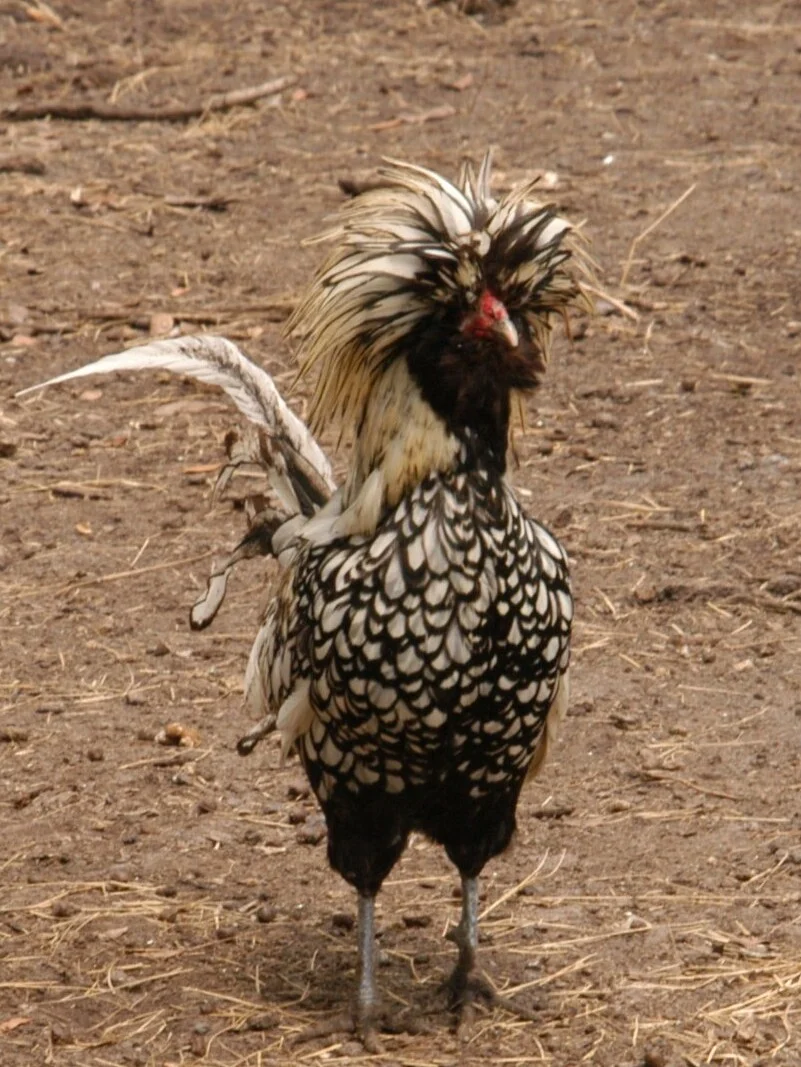
A European crested breed, with uncertain beginnings
Polish, also called Poland, appears in European art and poultry records long before modern breed standards. Its precise early origin remains uncertain, and its name should not be treated as proof of a single founding country. Dutch fanciers contributed to its development, and it later became established in Britain and the United States. Once valued for white eggs, it increasingly attracted exhibition interest. Today's keeper should appreciate both that laying background and the practical consequences of the crest that made the breed so recognizable.
Look for a prominent crest, a V-shaped comb that may be hidden, clean legs and four toes. Bearded and non-bearded forms and multiple color varieties exist, with distinctions set by the relevant national standard. White Crested Black is one familiar presentation rather than the whole breed. Hens typically have a more rounded crest than males, but crest shape is not an infallible early chick-sexing method. Polish differs from five-toed, feather-footed or differently structured crested breeds, even when their head feathers initially look similar.
The Conservancy gives around 150 eggs and describes little broodiness. The crest can impair awareness, so production and friendliness should be weighed alongside protected housing and calm handling.
Young crested birds need observation, not a promised laying date
Crest and adult plumage develop as youngsters grow. The laying reference describes seasonal behavior without establishing a universal first-egg week. Our suggested record follows hatch date, development and first lay, while daily checks confirm the bird can see and reach food and water. Do not assign a youngster's sex solely from an early crest photograph. Give developing birds a calm, predictable environment and a safe introduction to larger flockmates; a visually striking juvenile still needs the same age-appropriate ration and chick care as its companions.
A Polish can be friendly yet startle readily when its crest limits awareness. Those behaviors are compatible, rather than evidence that the bird is inexplicably nervous. Our recommendation is to speak as you approach, move predictably and avoid sudden reaching from behind. Observe introductions closely: a crested bird may miss the warning signals of an assertive flockmate. A covered run and a consistent routine make calm interaction easier. Do not interpret familiarity with people as proof that the chicken can safely detect every outdoor predator.
Provide a dry, ventilated coop and protected outdoor space. Check the crest after wet weather and during freezes; head feathers can become saturated or icy even when the body remains sheltered. Make feeders and waterers easy to locate without forcing the bird through a crowded corner. Polish can fly, so lightweight appearance does not justify a low, open enclosure. Our practical recommendation is to inspect the bird's view at ground level and near the feeding station. A charming crest should not obscure everyday access, social signals or hazards.
Select a usable bird as well as an attractive crest
Choose the variety, size form and bearded or non-bearded requirements before making breeding comparisons. Maintain family and hatch records, with notes on soundness, egg production and everyday function. Our recommendation is to include unobstructed feeding and comfortable movement in selection rather than rewarding crest volume alone. A chicken that photographs impressively still needs to live effectively in its enclosure. Polish generally has limited sitting tendency, so establish an incubation plan before collecting breeding eggs instead of relying on the hens to raise every hatch themselves.
For a keeper who enjoys detail and protected housing
Polish can be rewarding if you want crested character and white eggs and are willing to check the extra head feathering. It is less convenient for an exposed ranging system or a rough flock where visual awareness and feeder access are constant problems. Compare Houdan and Crèvecoeur for other crested histories, and Silkie for a very different feather texture and broody role. Choose a healthy, functional individual and suitable companions; ornamental appeal should add to a good care plan rather than replace one.
Avoid exposed free-ranging based solely on appearance or a calm disposition. Check sightlines, crest dryness and access to food, especially when housed with assertive birds.
These priorities apply the breed traits above to a backyard setup. Use the chick-to-coop planner for young birds and the housing guides for your coop plan.
Questions keepers ask
Does the name prove Polish came from Poland?
No. Its early origin and the derivation of its name remain uncertain. It has a long European history, with important development beyond Poland. This profile distinguishes that uncertainty from the well-documented modern breed and its practical care requirements. [1][3]
Why does a friendly Polish suddenly jump away?
A crest can limit what the bird sees, so an unexpected approach may startle it. Speak before reaching and move predictably. Repeated difficulty seeing food, companions or hazards deserves a care review rather than being dismissed as personality. [1]
Can Polish free-range safely?
No breed makes unrestricted ranging automatically safe. Crest-related awareness concerns make a protected, covered space particularly useful here. Consider local predators and the individual bird's vision. A calm hen that trusts people may still fail to notice a danger overhead. [1][6]
Will the hens incubate the eggs?
They generally have low sitting tendency. Arrange an incubator or an appropriate broody hen if hatching is essential. Their white-egg laying background and their ornamental crest do not establish dependable mothering behavior. [1][5]
Reviewed October 7, 2026. Breed organizations, university references and conservation histories establish breed traits; hatchery estimates describe named supplier lines. This profile identifies the source of the figures instead of treating them as one standardized trial.
Our care recommendations and suggested records apply those traits and Extension husbandry guidance to a backyard flock. They are editorial advice, not results from a controlled breed trial. A breed reputation does not establish an individual bird's behavior, health or readiness to move outdoors.
Egg-size words are source descriptions, not measured carton grades. Adult weights refer to mature birds, not market or pullet weights. Conservation categories describe U.S. populations. Examples of varieties are not a complete list of every national registry's accepted colors.