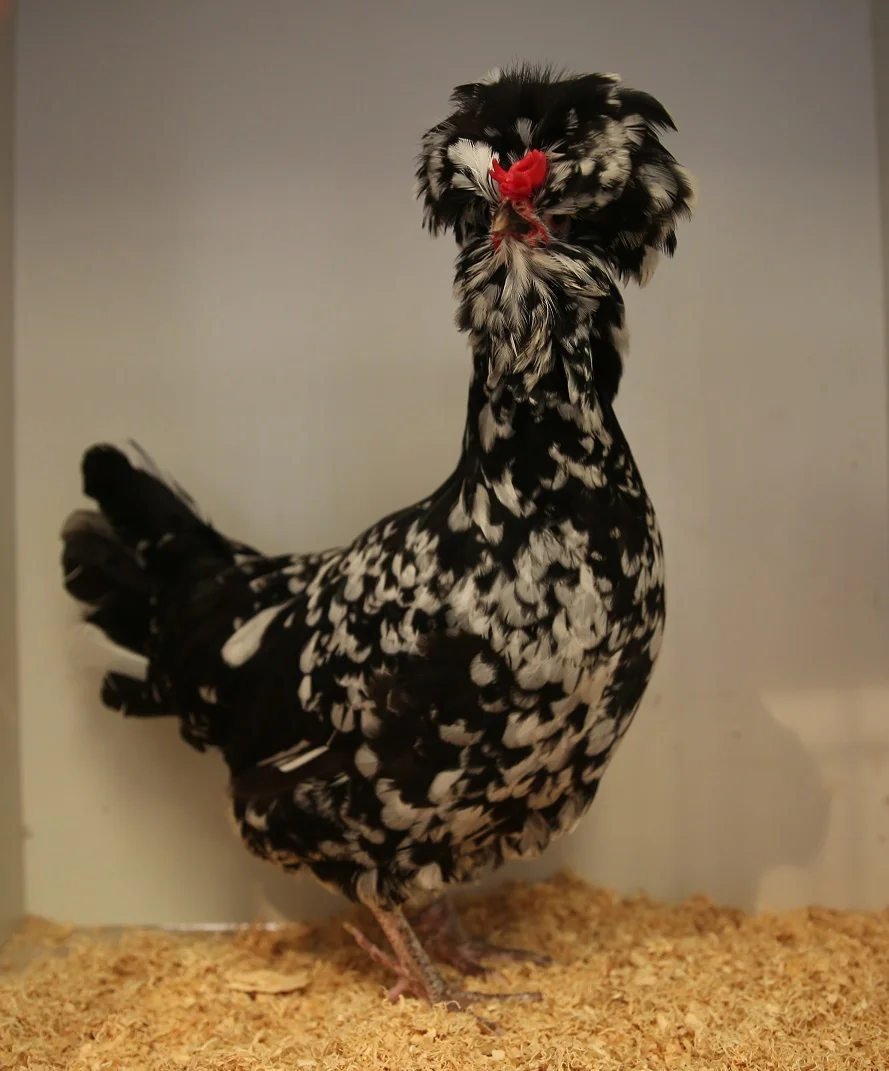
A French market bird, not just an ornamental crest
Houdan takes its name from a French town and developed within a table-poultry tradition. Five-toed local birds and crested ancestry contributed to the type. Later selection produced the familiar mottled exhibition presentation, while its usefulness as a white-egg and table bird remained part of the history.
The crest often dominates a photograph, but it should not obscure the breed's body and toe characteristics. A Houdan is not simply any mottled Polish-looking chicken. Identification and preservation require the complete type, not only a dramatic head ornament.
Houdan has a crest, facial feathering, five toes and clean legs. Its divided comb is commonly described as butterfly-like. Mottled black-and-white is the familiar presentation; white also belongs to the breed's variety history under particular standards.
Adult weights need to be separated from the lighter pullet and cockerel figures sometimes used in short summaries. Our practical recommendation is to observe a normal standing pose, legs and toes as well as the head. A dense crest can hide details that are essential for distinguishing it from Crevecoeur or Polish.
The Conservancy gives 150–230 white eggs and notes useful sitting. A crested five-toed table breed needs its body and head features considered together; the published adult weights differ from immature market weights.
The Conservancy describes youngsters as readily reared and quick-growing, but that does not establish one universal first-egg week. Keep hatch date, growth and laying onset separate. The source's broad egg range describes adult production across different conditions and strains.
Our recommended record notes crest development, weight and first eggs together, then tracks actual output and any sitting. This helps avoid treating an adult-looking head ornament as proof that a pullet has reached her mature body or laying stage.
Houdans are often gentle and approachable, although individual males can differ. Their head feathering can make it harder to notice an approaching bird or person. In a mixed flock, gentleness and unusual feathering can become a disadvantage with assertive companions.
Our suggestion is to approach where the bird can notice you and use a familiar call. Observe normal feeding and inspect for crest pecking. Keep an alternative pen available if a mixed group repeatedly prevents a quiet Houdan from using resources comfortably.
A covered, dry daytime area is especially useful. Position drinkers so facial feathers are not constantly soaked, and inspect the crest after wet or freezing weather. Good ventilation remains necessary even when keeping the shelter dry.
Our practical recommendation is to make predator protection independent of the bird's field of view. Keep equipment accessible without forcing the crest into narrow openings, and allow comfortable body movement at adult size. Summer shade and airflow are still essential; a preference for dry conditions is not a reason to expose birds to excessive heat.
Preserve toe structure, type and useful performance
Select more than the biggest crest. Houdan's body, five-toed feet, comb, facial feathering and variety presentation all belong in the assessment. Our suggested records connect parent group, mature weight, eggs, fertility and hatch results so the utility bird remains visible behind the ornament.
Broodiness can vary by strain. Record the actual hens' sitting and hatch completion before planning natural replacements. Keep purebred matings separate from mixed crested projects; five toes or a mottled crest added to a cross does not establish Houdan identity.
Houdan suits someone who wants a distinctive French heritage bird and can provide protected, dry housing with compatible companions. It is less convenient for an exposed wet range or a flock of dominant crest-peckers. Compare Crevecoeur, Polish and Faverolles to understand which combination of crest, toe count and utility you prefer. Choose the husbandry setup with the attractive appearance.
A sheltered run and dry crest are practical priorities. Plan introductions and feeding access around limited vision rather than assuming a gentle breed can fend for itself in every flock.
These priorities apply the breed traits above to a backyard setup. Use the chick-to-coop planner for young birds and the housing guides for your coop plan.
Questions keepers ask
How does Houdan differ from Polish?
Houdan has five toes and its own heavier utility type and comb presentation. Polish generally has four toes and a different breed outline. A large crest alone is not sufficient to identify either bird. [1][3]
Does the crest mean the bird cannot see anything?
Not necessarily, but large head feathering can restrict visibility. Observe the individual bird and provide dependable protection. Our recommendation is to judge its practical ability to navigate and find equipment rather than assume every crest has the same effect. [1]
Are Houdans reliably broody?
The source describes strain differences. Some hens sit and others do not. Record completed hatches in the actual flock if you intend to rely on natural incubation. [1]
Why does wet-weather shelter matter so much?
Wet crest and beard feathers can create problems in cold weather and make ordinary care less comfortable. Covered space and suitable drinker placement are practical priorities alongside ventilation, rather than merely ways to keep the photograph tidy. [1]
Reviewed October 7, 2026. Breed organizations, university references and conservation histories establish breed traits; hatchery estimates describe named supplier lines. This profile identifies the source of the figures instead of treating them as one standardized trial.
Our care recommendations and suggested records apply those traits and Extension husbandry guidance to a backyard flock. They are editorial advice, not results from a controlled breed trial. A breed reputation does not establish an individual bird's behavior, health or readiness to move outdoors.
Egg-size words are source descriptions, not measured carton grades. Adult weights refer to mature birds, not market or pullet weights. Conservation categories describe U.S. populations. Examples of varieties are not a complete list of every national registry's accepted colors.