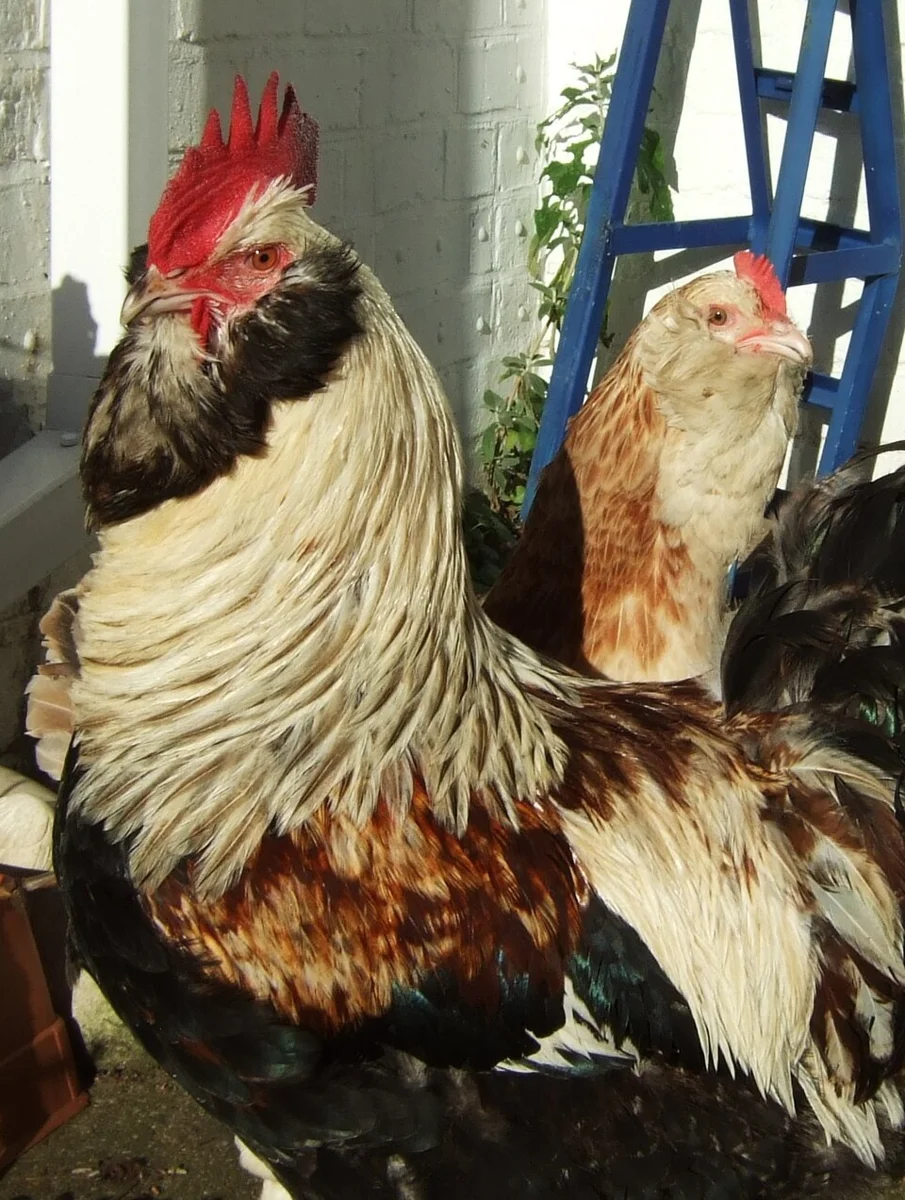
Faverolles takes its name from a French village and developed from several established breeds selected for practical table and egg qualities. Its later exhibition identity includes the familiar Salmon pattern. British and American breeding contributed to the different presentations seen in modern references.
The name refers to the breed even when discussing one bird. It is a substantial dual-purpose chicken, not simply a small ornamental bird with a beard. That working background helps explain why useful body structure and production belong alongside feather color in a profile.
Faverolles combines a beard and muffs, a single comb, five toes and feathering on the legs. Salmon hens and males look markedly different, so the rooster should not be identified by expecting a larger version of the hen's soft-colored pattern. White is another familiar recognized presentation, while national variety lists differ.
Adult weights are heavier than the pullet and cockerel weights sometimes repeated in short summaries. Use the mature figures in the grid and assess condition beneath the feathering rather than judging body size from the beard and fluff alone.
The Conservancy gives 150–200 or more eggs and describes winter laying. Some hens sit. Salmon males and females look different, so plumage and body traits should be evaluated by sex as well as variety.
The breed offers a useful balance of eggs and traditional table qualities, but the cited references do not establish one fixed first-lay week across all lines. Record hatch date, growth and the first egg separately. A well-feathered youngster is not necessarily at its mature weight.
Our recommended laying record includes seasonal eggs and actual broody spells. Some hens sit, and winter laying is part of the breed's reputation. Neither tendency means every individual will follow the same schedule or complete a hatch reliably.
Faverolles are generally active but gentle, and their approachable nature is part of their appeal. In a mixed flock, that can put them at a disadvantage with more forceful chickens. Facial and leg feathering also provide features that other birds may peck.
Our practical suggestion is to choose compatible companions and observe normal feeding, not just behavior when treats arrive. Watch whether quieter hens can remain at the feeder and settle comfortably at night. A friendly breed description does not mean every rooster enjoys handling or every mixed group will work.
Provide clean, well-drained surfaces and inspect the feet beneath their feathers. Place the drinker so that the beard does not become persistently wet. These are practical applications of the breed's feathering, especially useful when rain and cold weather overlap.
Our recommended enclosure makes resting and nesting easy for a substantial bird and gives gentle hens ways around more assertive companions. In summer, check afternoon shade, fresh water and airflow. A reputation for winter laying does not remove the need for seasonal comfort and dry, ventilated shelter.
For Salmon Faverolles, study male and female pattern expectations separately. Selecting only a striking rooster can neglect the females' type and productive contribution. Five toes, beard, leg feathering and correct body structure all belong in the assessment.
Our suggested record connects adult photographs, mature weight, egg production, fertility and hatch results to each parent group. Retain actual gentle behavior as well as appearance if the flock's purpose includes companionship. Label crosses accurately; adding a beard or fifth toe does not establish purebred Faverolles identity.
Faverolles suits someone who values a gentle, distinctive dual-purpose breed and can keep facial and foot feathers clean. It is less convenient in persistent mud or a pen dominated by assertive birds. Compare Dorking for another five-toed utility breed, Houdan for a crested French alternative and Cochin for a feather-footed companion option. Match the flock company and ground conditions before choosing the charming face.
Dry footing and monitoring of flock bullying are useful priorities. In a mixed flock, make sure gentler birds can reach feed and water without being displaced.
These priorities apply the breed traits above to a backyard setup. Use the chick-to-coop planner for young birds and the housing guides for your coop plan.
Questions keepers ask
Why does the Salmon rooster look unlike the hen?
The variety has different male and female plumage presentations. Compare each sex with its appropriate description. A correctly patterned rooster is not simply a larger, darker Salmon hen. [1][3]
Does a fifth toe mean it is a Silkie?
No. Several breeds have five toes. Faverolles has its own combination of beard, leg feathering, single comb and body type. Identify the whole bird instead of assigning a breed from one toe feature. [1][2]
Will Faverolles cope with assertive hens?
Not every mixed group works. They can be displaced or pecked by more forceful birds. Our recommendation is to monitor resource access and keep a separation option if gentler hens repeatedly lose out. [1]
Why do published weight figures differ?
Some summaries repeat juvenile rather than mature weights. The grid identifies adult hen and rooster figures. Compare birds of the same age, sex and size form before deciding that one reference or bird is unusually small. [1][2]
Reviewed October 7, 2026. Breed organizations, university references and conservation histories establish breed traits; hatchery estimates describe named supplier lines. This profile identifies the source of the figures instead of treating them as one standardized trial.
Our care recommendations and suggested records apply those traits and Extension husbandry guidance to a backyard flock. They are editorial advice, not results from a controlled breed trial. A breed reputation does not establish an individual bird's behavior, health or readiness to move outdoors.
Egg-size words are source descriptions, not measured carton grades. Adult weights refer to mature birds, not market or pullet weights. Conservation categories describe U.S. populations. Examples of varieties are not a complete list of every national registry's accepted colors.