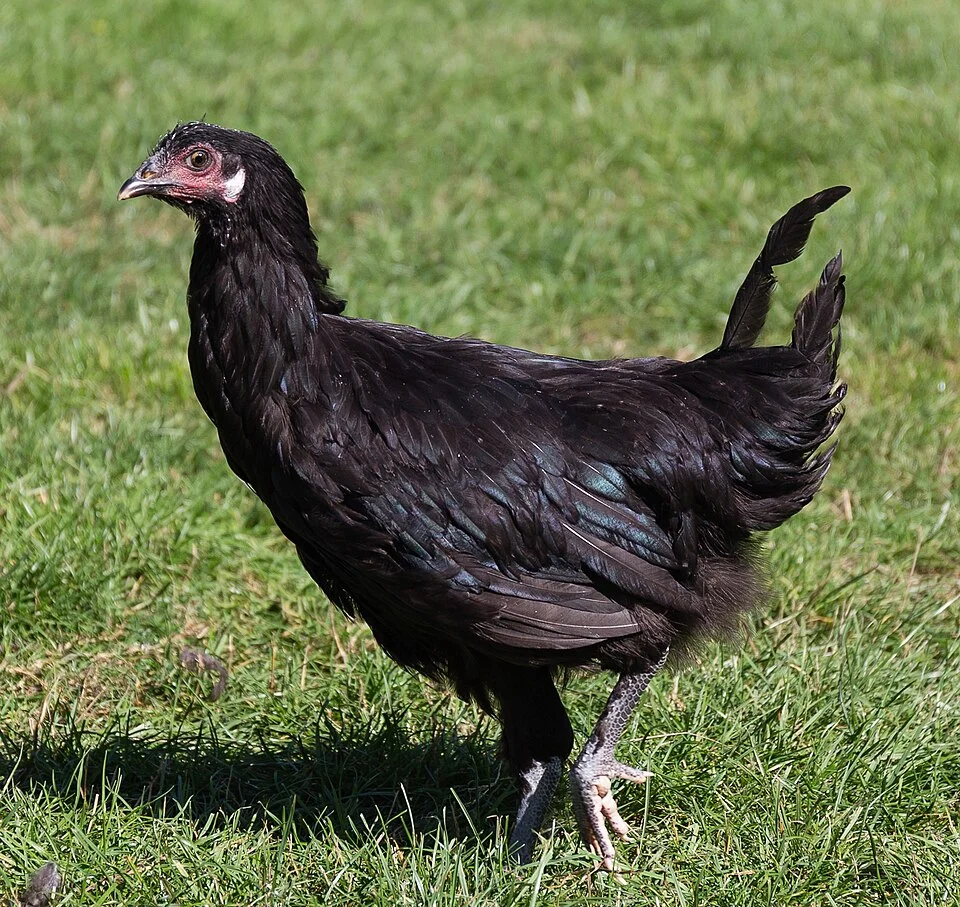
La Fleche takes its name from a French town, rather than being named simply for an arrow-shaped comb. Its history belongs to France's table-poultry tradition, with particular interest in fine flesh and a substantial breast. The exact early origin is less secure than that documented regional role.
It later became a specialized exhibition and preservation bird. The distinctive comb can attract attention, but keeping the breed involves its body, reproduction and useful traits as well as an unusual head silhouette. It is a separate breed from other horn-combed French chickens.
The divided comb resembles a pair of horns. La Fleche has clean legs, four toes, pale earlobes and close feathering over a substantial body. Black is the familiar presentation in American references, while national variety descriptions differ.
Close feathers can conceal how substantial the bird actually is. Our practical recommendation is to compare mature weight and body outline alongside the comb. A horn-like comb alone cannot distinguish a true La Fleche from a mixed bird or from a different French breed with a similar feature.
The Conservancy describes 140–220 eggs, especially from March through October, and little broodiness. Its table qualities and active behavior are more relevant than assuming year-round egg uniformity.
The Conservancy describes comparatively slow chick growth. Its egg figure is also qualified by a March-through-October laying interval, rather than an assumption of identical output every month. Keep those pieces of context when planning the flock.
Our suggested record separates hatch date, growth, first egg and seasonal production. The sources do not establish one dependable first-lay week for every current strain. Traditional table quality and adult development are different goals from a modern broiler's short processing calendar.
La Fleche is generally active and can be flighty around people. It is a less obvious choice for someone chiefly seeking a cuddly pet. That does not make it an unmanageable breed, but it calls for a keeper comfortable with a more independent flock.
Our recommendation is to establish a familiar feeding and handling routine and provide a secure inspection area. Avoid evaluating temperament only through an attractive posed photograph. In mixed groups, observe normal resource access and adult male compatibility rather than assuming every pen combination will work.
Give an active bird room to investigate, with overhead containment where needed. La Fleche can fly, so a low open fence is an unreliable basis for evening retrieval. Our suggested setup makes the intended coop more accessible and familiar than a tree roost.
The breed favors warmer conditions, making dry, protected winter accommodation important in colder locations. Summer shade, water and airflow remain necessary. Inspect the actual occupied space and bird condition, rather than using “warm-climate breed” as a substitute for a seasonal care plan.
Select the correct body, comb and variety as a whole. The most dramatic horns are not the entire breeding goal. Our suggested records connect adult weight, growth, eggs and hatch results with each parent group so the traditional utility behind the ornament remains visible.
La Fleche is generally non-broody, so arrange incubation separately for planned replacements. A preservation project also needs family origins and honest cross labels. Mixing another V-combed breed into the flock does not preserve La Fleche merely because the resulting heads look similar.
La Fleche suits someone interested in French poultry history and willing to provide space, secure containment and a deliberate breeding plan. It is less convenient for a severe exposed winter, a lap-pet goal or a very short growing project. Compare Crevecoeur and Houdan for other French heritage options. Choose the practical routine and source identity along with the unusual comb.
A warmer-climate candidate with active foraging behavior. Protect against severe cold and preserve unrelated breeding stock when maintaining a small rare-breed flock.
These priorities apply the breed traits above to a backyard setup. Use the chick-to-coop planner for young birds and the housing guides for your coop plan.
Questions keepers ask
Was the breed named after its arrow-like comb?
The name comes from the town of La Fleche. The comb makes the arrow association memorable, but that is not the same as the breed's geographic naming history. [1]
Can I treat its egg total as uniform year-round laying?
No. The source's count is qualified by a March-through-October interval. Your flock may differ, but the original seasonal context should not be removed when using the reference for planning. [1]
Does the V comb mean it is Crevecoeur?
No. La Fleche and Crevecoeur have different overall types and head presentations. Consider crest, beard, body and the applicable standard as well as the divided comb. [1][2]
Will La Fleche provide broody mothers?
It is generally a non-broody breed. Arrange an incubator or suitable sitter if you want a planned hatch. An occasional exception is not a reliable flock replacement strategy. [1]
Reviewed October 7, 2026. Breed organizations, university references and conservation histories establish breed traits; hatchery estimates describe named supplier lines. This profile identifies the source of the figures instead of treating them as one standardized trial.
Our care recommendations and suggested records apply those traits and Extension husbandry guidance to a backyard flock. They are editorial advice, not results from a controlled breed trial. A breed reputation does not establish an individual bird's behavior, health or readiness to move outdoors.
Egg-size words are source descriptions, not measured carton grades. Adult weights refer to mature birds, not market or pullet weights. Conservation categories describe U.S. populations. Examples of varieties are not a complete list of every national registry's accepted colors.