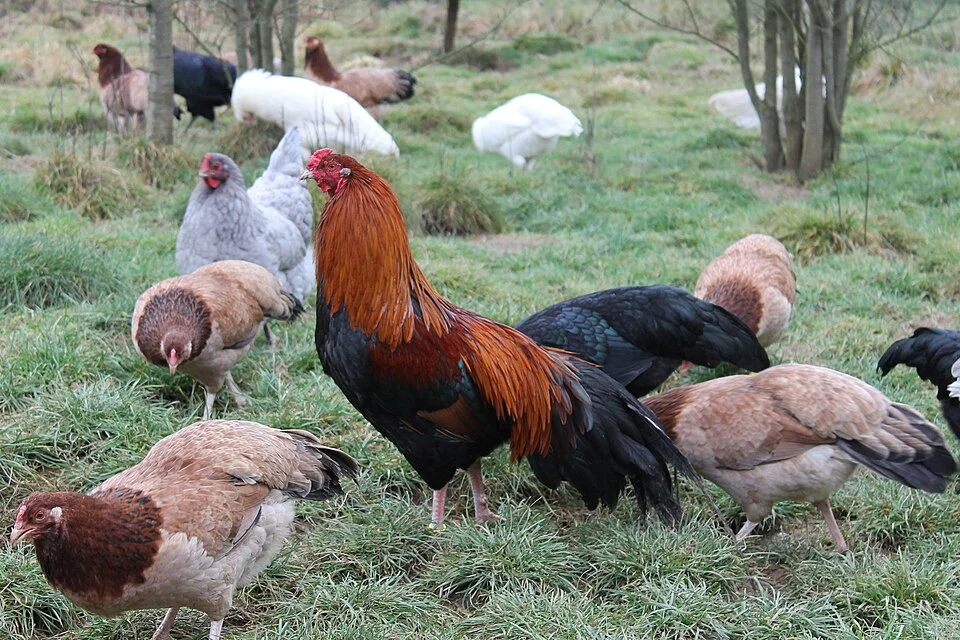
Cubalaya developed in Cuba from Asian and European gamefowl influences and reached U.S. recognition in 1939. It carries a history of utility as well as ornament. In American keeping, exhibition and ornamental selection can mean a flock differs from birds maintained primarily for eggs and table use.
That distinction is useful before purchasing. A beautiful tail does not establish a particular production level, and a seller's bantam line cannot be used as a direct size reference for large fowl. Identify the project as well as the breed name.
The downward-sloping, generously feathered tail creates the characteristic “lobster tail” outline. A pea comb, close feathering and clean legs complete the general presentation. Black-breasted red, black and white are familiar standard varieties, with males and females differing in color presentation.
Both large-fowl and bantam forms exist. The university lists bantam adults at roughly 22 oz for hens and 26 oz for males; those figures should not be compared with the large-fowl pounds in the grid. Observe the entire outline rather than identifying the breed from red-and-black plumage alone.
The reference's 125–175 eggs and sitting ability suit a multipurpose flock. Reproductive maturity and full adult body development are different milestones; the Conservancy describes much slower completion of adult size.
The Conservancy separates reproductive maturity, around six to seven months, from the much longer development of full adult size. This is an important distinction for a breed whose eventual appearance can keep changing. A bird can be capable of breeding without having its final mature outline.
Our suggested records track age, weight, tail development, first eggs and later adult photographs. Do not compare a young male's short tail with an older show bird and assume the youngster will never develop the proper form.
Cubalayas may be remarkably approachable with people while remaining assertive toward other birds. Those two relationships should be assessed separately. A hand-friendly chick is not a guarantee of a peaceful adult male group.
Our recommendation is to observe social behavior during development and keep a separation option for incompatible birds. Establish ordinary handling early, but build predator protection independently of the flock's apparent bravery. A bird that shows little fear still needs an enclosure that keeps danger out.
Cubalaya is comparatively suited to warm conditions and active ranging. Provide shade and water rather than treating heat tolerance as a reason to expose birds to the hottest part of the yard. Our suggested layout allows normal movement and enough room for the long tail to avoid repeatedly rubbing against narrow equipment.
For a cooler location, assess shelter before buying. During confinement, offer usable activity space and compatible flock groups. Bantams need their own equipment and protection assessment; their existence does not mean that a large-fowl setup automatically suits the smaller form.
The unusual tail is a breeding priority, but it should be considered alongside body balance, sound legs, temperament and reproduction. Our recommended record separates fertility, hatch results and later adult development. Slow final maturation makes dated photographs especially useful.
State the size form and variety in mating records and sales descriptions. A conservation project should maintain the Cubalaya's identity rather than gradually becoming an unrecorded assortment of long-tailed crosses. Select the actual birds' usefulness and behavior as well as their striking ornamental presentation.
Cubalaya suits someone with suitable warmth, room and an interest in unusual heritage poultry. It is less convenient where severe winters, cramped equipment or incompatible male groups dominate the plan. Choose it for the whole project, not just the tail photograph. If table eggs are the only aim, compare more specialized layers before committing to its development timetable.
Warm, humid conditions suit its background. Flock assertiveness and slow full-body development matter more than its handsome tail when deciding companions and breeding plans.
These priorities apply the breed traits above to a backyard setup. Use the chick-to-coop planner for young birds and the housing guides for your coop plan.
Questions keepers ask
Does an adult-looking tail mean the bird is fully mature?
Not necessarily. Reproductive ability and full adult development are separate milestones. Keep age and weight records and compare photographs over time rather than using tail length alone as the maturity test. [1]
Are all Cubalayas bantams?
No. Large-fowl and bantam forms exist. Confirm the form before applying weight or egg-size expectations. The large-fowl fact grid is not the appropriate target for a mature bantam. [3][4]
Will a friendly Cubalaya rooster get along with other males?
Friendliness with people does not establish compatibility with other birds. Observe adult social behavior and maintain a separation option. Do not use early hand-feeding behavior as the only test for a mixed male group. [1]
Can I use a heat-tolerance label instead of summer shade?
No. Comparative tolerance does not remove the need for shade, airflow and dependable water. The enclosure and conditions still determine whether birds can cope safely with a hot, humid day. [5]
Reviewed October 7, 2026. Breed organizations, university references and conservation histories establish breed traits; hatchery estimates describe named supplier lines. This profile identifies the source of the figures instead of treating them as one standardized trial.
Our care recommendations and suggested records apply those traits and Extension husbandry guidance to a backyard flock. They are editorial advice, not results from a controlled breed trial. A breed reputation does not establish an individual bird's behavior, health or readiness to move outdoors.
Egg-size words are source descriptions, not measured carton grades. Adult weights refer to mature birds, not market or pullet weights. Conservation categories describe U.S. populations. Examples of varieties are not a complete list of every national registry's accepted colors.