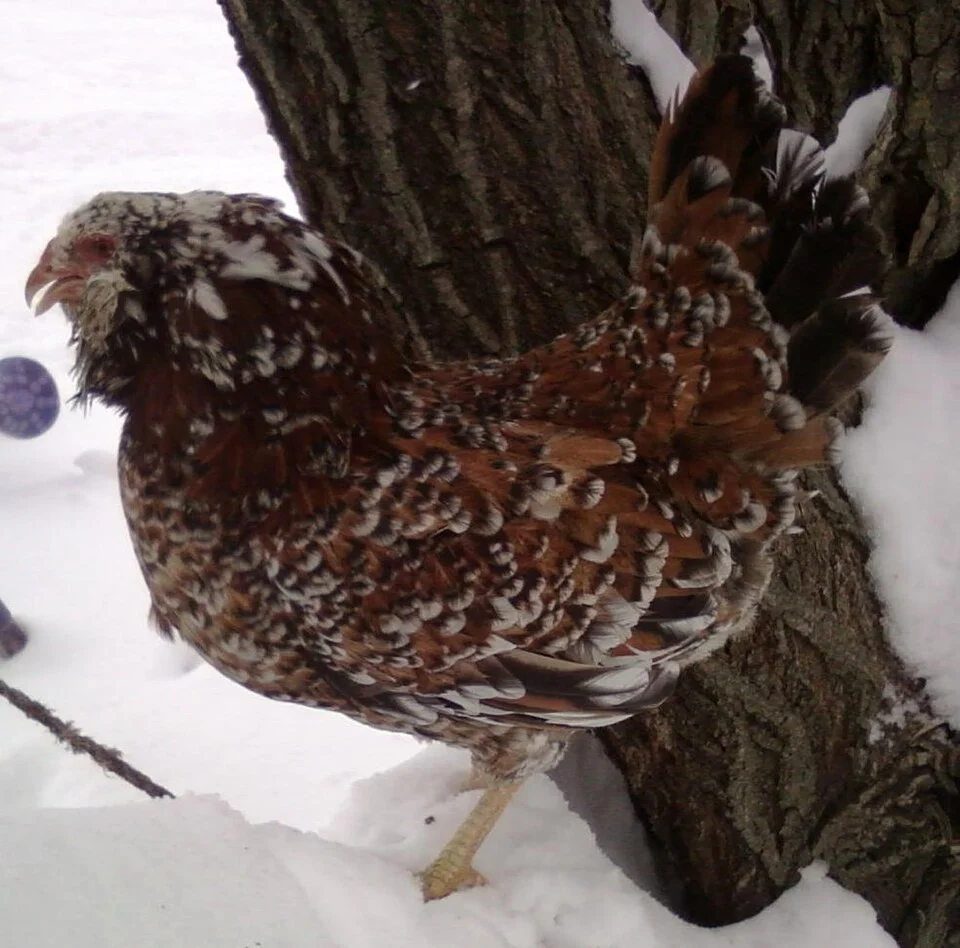
Despite its familiar name, Orloff history reaches back to the Gilan region of Persia, now Iran. Russian promotion and development brought the breed to wider attention under the Orloff name, and later European breeders maintained it. British records also distinguish the subsequent bantam history. This is a breed with a table-bird and preservation background, rather than a modern laying hybrid. Its ancestry and development help explain why a keeper might value its character and cold-oriented traits despite comparatively modest egg production.
Upright carriage, a feathered face and a small comb
Look for a substantial, upright bird with a beard, muffs and a densely feathered neck. The comb is small, described as cushion or strawberry-type, and the legs are clean. Spangled birds are familiar, but national standards include other varieties; an unusual color should be evaluated against the appropriate standard and family records. Large fowl and bantams exist. Face feathering and body posture are important identifying features, but a bearded red cross is not automatically an Orloff simply because it resembles a photograph.
The Conservancy gives about 100 small-to-medium eggs and little broodiness. Cold tolerance, table-bird history and conservation interest make a better case for the breed than maximum laying output.
The Conservancy's cold-tolerance description concerns mature birds. It does not supply a fixed outdoor-ready age or remove the need for suitable brooding. Our suggested development record follows hatch date, weight, feather coverage and first lay. Plan the move outside around actual condition and weather, with a secure, sheltered introduction. Do not infer an exact finishing age from adult weight or an upright silhouette. Modest laying expectations also mean a first-egg date and later seasonal record are more informative than an assumption of commercial-layer performance.
The reference describes calm birds without promising passive, cuddly behavior. That is a useful distinction in a mixed flock: an Orloff may be comfortable around people while standing its ground with companions. Our recommendation is to watch introductions, feeding access and handling separately. A bird that ranges quietly may resist being caught, and a rooster needs his own conduct assessment. Provide a predictable routine and enough room for birds to disengage. Avoid forcing a temperament label to cover every situation in which you interact with the flock.
Cold-oriented features still need dry shelter and summer relief
A small comb and thick neck feathering are useful cold-oriented features, not a reason to leave the flock exposed. Provide dry bedding, ventilation without direct drafts on resting birds, and reliable water access. Check facial feathering and feet after prolonged wet weather. In warm conditions, supply shade and airflow for a substantial bird. Our practical recommendation is to assess the coop during both a damp winter spell and a hot afternoon. A design that suits one season may need a covered outdoor area or better summer ventilation for the other.
Preservation needs more than a striking spangled pair
For a preservation flock, keep family origins, parent identities and hatch results alongside records of structure and usable performance. Determine the standard and size form you are maintaining. Our recommendation is to assess the characteristic head and body without letting attractive spangling outweigh soundness, manageable behavior or fertility. The generally low sitting tendency also calls for an incubation plan. Retaining several documented family options is more useful for a continuing project than repeatedly breeding a single favorite pair because they photograph especially well together.
For character and preservation rather than the largest egg basket
Orloff makes sense when you value a distinctive substantial bird, adult cold tolerance and maintaining a less common breed. Its modest annual laying reference should be part of that decision. Compare Chantecler and Buckeye if cold-oriented farm traits are important, while recognizing their different histories and performance. If a large, uninterrupted supply of eggs is essential, a laying-focused family is a more direct choice. Choose Orloff because its overall role fits your flock, rather than expecting its impressive appearance to imply maximum output.
Adult cold-oriented traits and modest laying make conservation and character central to its appeal. Young birds still need development-based chick care, and mature birds need dry shelter and relief from summer heat.
These priorities apply the breed traits above to a backyard setup. Use the chick-to-coop planner for young birds and the housing guides for your coop plan.
Questions keepers ask
Did Russian Orloff originate entirely in Russia?
No. The histories trace its roots to Persia and describe later Russian development and promotion. The name reflects an important stage in the breed's history, rather than a complete account of its ancestry. [1][2]
Can Orloff chicks go outside early because the breed tolerates cold?
That should not be assumed. Adult cold tolerance is different from chick readiness. Observe feather coverage, health and weather, and provide suitable brooding and shelter. Breed identity does not replace a development-based plan. [1][4]
Does an upright appearance mean it will fight?
Posture is not a temperament diagnosis. The reference describes a calm but self-possessed bird. Assess individual behavior around people and flockmates, and intervene when there is repeated harm rather than making predictions from an upright stance. [1]
Is Orloff a high-output brown-egg breed?
Its cited laying estimate is modest, with small-to-medium light brown eggs. Preservation, character and adult hardiness make a stronger case than egg volume. Laying records remain useful, but the breed name is not a promise of commercial-layer output. [1][5]
Reviewed October 7, 2026. Breed organizations, university references and conservation histories establish breed traits; hatchery estimates describe named supplier lines. This profile identifies the source of the figures instead of treating them as one standardized trial.
Our care recommendations and suggested records apply those traits and Extension husbandry guidance to a backyard flock. They are editorial advice, not results from a controlled breed trial. A breed reputation does not establish an individual bird's behavior, health or readiness to move outdoors.
Egg-size words are source descriptions, not measured carton grades. Adult weights refer to mature birds, not market or pullet weights. Conservation categories describe U.S. populations. Examples of varieties are not a complete list of every national registry's accepted colors.