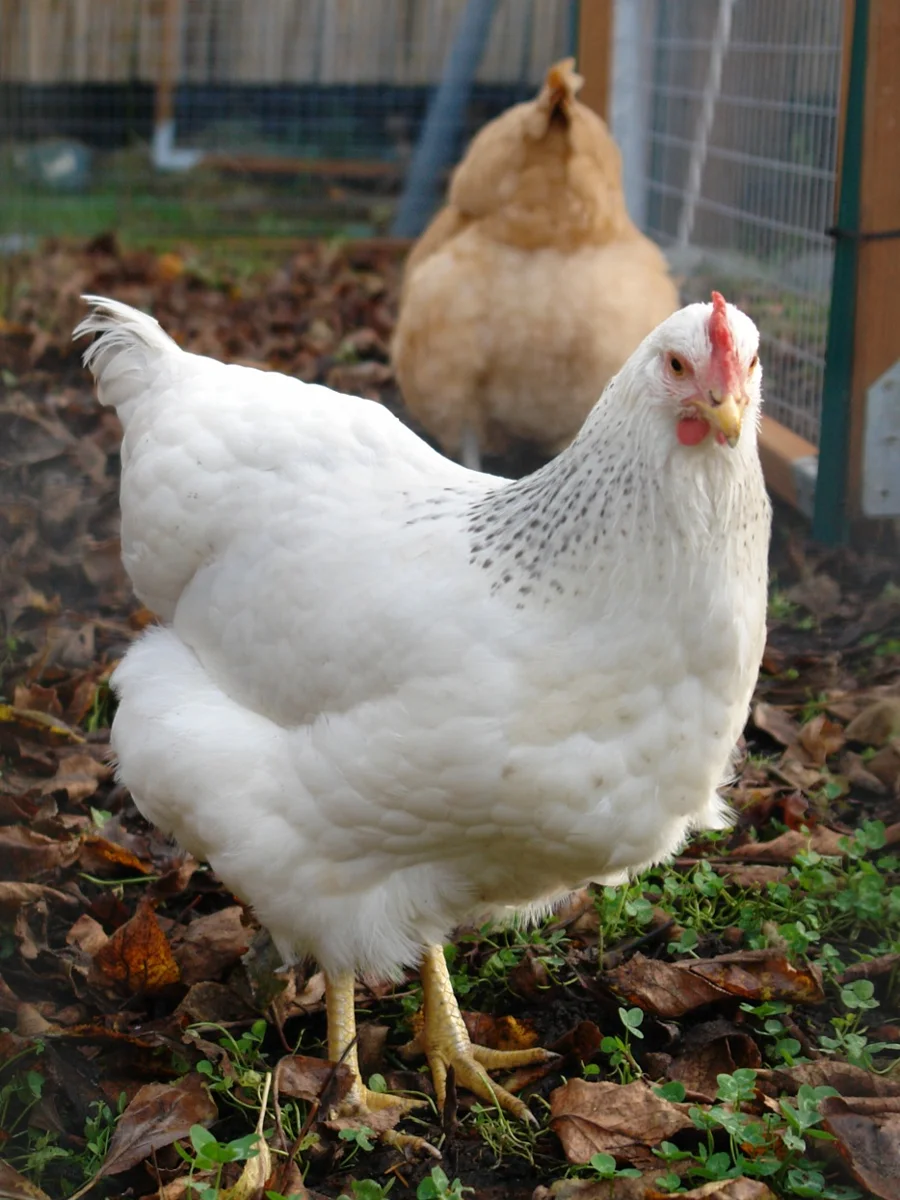
Delaware arose from pale-colored offspring in a New Hampshire and Barred Plymouth Rock breeding project in Delaware. George Ellis developed those birds into a consistent type during the 1940s. The original goal combined useful growth with laying, before modern commercial broilers displaced traditional table breeds.
Its history is more recent than that of many heritage chickens, but the bird is a distinct standardized breed. A modern cross carrying the Delaware name is not automatically the same as a purebred preservation flock.
The white body contrasts with dark barring in the neck and tail region. This is different from assuming that every white bird with black markings is the same Columbian-pattern breed. Delaware has a single comb, yellow clean legs and its own substantial body type.
The grid uses identified adult weight references. Juvenile or market weights in other summaries can be lighter. Our practical recommendation is to compare mature hens with mature hens and include body condition, rather than interpreting a single weight from an undated sale listing as a universal standard.
The cited Cackle line is estimated at 200–280 eggs and described as non-setting. As a dual-purpose breed, body development matters as well as laying. People-friendly behavior does not guarantee that every bird is gentle with flockmates.
Delaware's development emphasized useful growth and egg production together. That does not make it equivalent to a rapid-growth meat hybrid. The named supplier's laying range is a current line example rather than proof that every preservation strain has identical output.
Our suggested record includes hatch date, development, first egg and eggs across a defined year. Keep growth and laying selection visible together if breeding replacements. This is more informative than retaining only the earliest pullet or the heaviest male.
Delawares are often curious and people-oriented, but confidence can also mean assertiveness within a flock. They may follow activity around the yard without becoming keen on being held. Noise matters where neighbors are close.
Our recommendation is to judge the source flock's everyday behavior and watch quieter companions around food and roosts. Give the birds room to investigate and a familiar return-to-coop routine. White plumage or a reputation for alertness should never be treated as a complete predator-risk assessment.
Provide useful daytime space, accessible feeders and comfortable roost routes. Our suggested enclosure includes places to investigate during periods of confinement, so an active bird is not restricted to a bare rectangle. Allow more than one route around shared resources when the flock has differing levels of confidence.
The single comb needs attention in freezing conditions, and substantial birds need summer relief as well. Check shade at the hottest occupied time, not only in the morning. Secure nighttime shelter remains essential regardless of a bird's color or apparent awareness of its surroundings.
A Delaware female crossed with a suitable New Hampshire or Rhode Island Red male can produce sex-linked offspring with different male and female color presentations. Reversing the mating is not equivalent: a Delaware male over those females produces a different result. The direction of the cross is central to the claim.
Keep that cross project distinct from purebred Delaware matings and label offspring accurately. Our suggested breeding records include parent group, chick markings, confirmed sex, growth and laying. Preserve overall body type and utility along with the recognizable dark markings.
Delaware suits someone who wants brown eggs, active heritage birds and a possible dual-purpose breeding project. It is less convenient when a very quiet neighborhood flock is the priority. Compare New Hampshire, Plymouth Rock and Dominique for related practical choices. Decide whether you want purebred Delaware or a purposeful cross before relying on a seller's familiar-looking white-and-black chicks.
A practical eggs-and-meat candidate. Watch introductions to a gentle flock: approachable behavior with people can coexist with assertiveness around other chickens.
These priorities apply the breed traits above to a backyard setup. Use the chick-to-coop planner for young birds and the housing guides for your coop plan.
Questions keepers ask
Does every white bird with dark neck feathers qualify as Delaware?
No. Several breeds and crosses can have superficially similar markings. Delaware's barred dark pattern, overall type, comb, legs and parentage all matter. A single plumage photograph does not establish the breeding identity. [1][2]
Does the sex-linked cross work in either direction?
No. The documented Delaware-female by red-male pairing is directional. Reversing the parents changes the offspring color result. Keep sire and dam identities, not just the names of two breeds, in the mating record. [6]
Are crossbred offspring still purebred Delawares?
No. A purposeful cross can be useful, but it should be described as a cross. Maintaining a purebred flock and making sex-linked production offspring are separate projects with different labeling and replacement goals. [1][6]
Are Delawares naturally quiet backyard birds?
Not uniformly. They can be vocal and outgoing. Assess the actual flock and your neighbor situation rather than treating a friendly temperament as a promise of low noise. [1]
Reviewed October 7, 2026. Breed organizations, university references and conservation histories establish breed traits; hatchery estimates describe named supplier lines. This profile identifies the source of the figures instead of treating them as one standardized trial.
Our care recommendations and suggested records apply those traits and Extension husbandry guidance to a backyard flock. They are editorial advice, not results from a controlled breed trial. A breed reputation does not establish an individual bird's behavior, health or readiness to move outdoors.
Egg-size words are source descriptions, not measured carton grades. Adult weights refer to mature birds, not market or pullet weights. Conservation categories describe U.S. populations. Examples of varieties are not a complete list of every national registry's accepted colors.