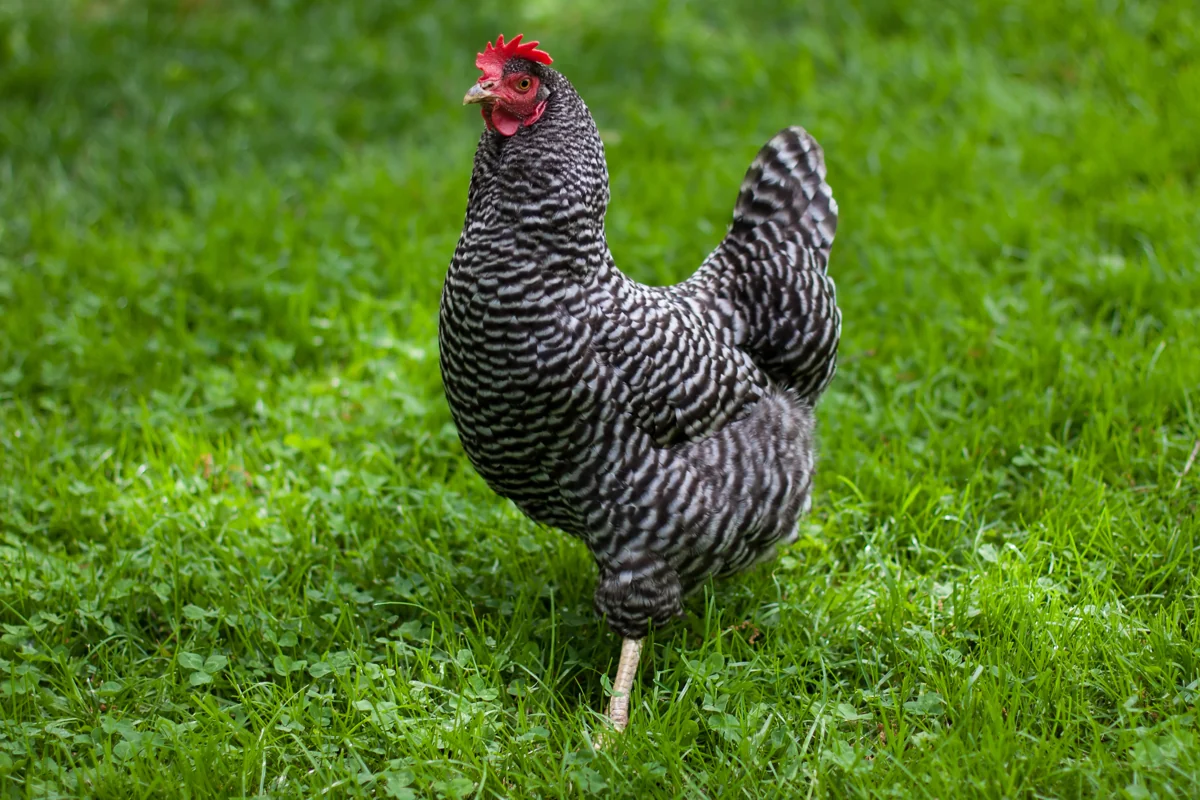
Despite the name, Holland was developed in New Jersey. The project sought a substantial dual-purpose chicken that laid white eggs at a time when many American farm breeds laid brown. Imported Dutch stock and established breeds contributed to its development, with recognition following in the mid-twentieth century.
Barred and white varieties belong to its history, but current availability is a separate question. Holland is not Dutch Bantam, and a barred white-egg bird does not become Holland from that pair of traits alone. Preservation requires the correct breed identity.
Holland has clean yellow shanks, a single comb and a substantial utility-bird body. The barred variety can resemble other barred American chickens, so egg color, body, comb and documented parentage should be considered together.
The university gives mature standard weights of approximately 6.5 lb for hens and 8.5 lb for males. Lighter market or short-summary figures describe a different basis. Our practical recommendation is to compare the whole bird and its age rather than treating the first weight found in a chart as a universal target.
This was developed to put white eggs into a dual-purpose farm bird. The Conservancy gives 200–240 eggs and describes broodiness. Oklahoma State's adult weights are used here rather than the smaller market-weight figure on another reference.
The Conservancy describes slow-to-moderate development and useful white-egg production. Those observations do not establish a fixed first-egg week for every current preservation flock. Growth, first laying and mature body weight need separate records.
Our suggested youngster record includes hatch date, weight observations, first egg and ordinary seasonal output. That is especially useful in a rare flock, where a small number of unusually fast or slow birds can otherwise dominate your impression of the entire breed.
Hollands are described as calm and people-oriented, with useful foraging ability. They can appeal to someone who wants a less excitable white-egg bird than many light Mediterranean choices. Individuals still vary, and calm temperament does not remove normal care around adult males.
Our practical recommendation is to give the flock an interesting, secure activity area and observe normal resource access. Compare behavior in ordinary conditions rather than only at a treat feeding. A rare breed can be a practical everyday flock, provided its needs suit the yard.
Provide room to forage or explore within a secure setup. Our suggested enclosure accommodates a substantial bird's movement, with feeders, nests and doorways that remain usable at adult size. Calm birds still need enough space to move around one another.
Holland can cope with cool conditions, but the male's exposed single comb needs attention in severe cold and damp weather. Summer shade and water are equally part of the plan. Secure shelter does the protective work; barred plumage is not a dependable predator barrier.
The white egg and dual-purpose body are both central to Holland's utility history. Preserve those alongside breed type rather than retaining only the barred appearance. Our recommended records connect mature weight, eggs, fertility and hatch results with each parent group.
In a small preservation population, keep family origins visible and label any crosses explicitly. A mixed barred flock cannot be described as Holland merely because some hens lay white eggs. A useful project maintains a breeding population as well as a display of attractive adults.
A quieter white-egg alternative with a preservation role
Holland suits someone interested in a substantial, calmer white-egg heritage bird and willing to locate identified stock. It is less convenient if immediate widespread hatchery availability is essential. Compare Leghorn for a lighter specialized layer and Dominique or Plymouth Rock for other barred American options with brown eggs. Make breed identity and the flock's breeding record part of the purchase decision.
A conservation-oriented flock benefits from documented parentage. Use the university's adult standard weights when planning housing; market weights and immature-bird weights describe different things.
These priorities apply the breed traits above to a backyard setup. Use the chick-to-coop planner for young birds and the housing guides for your coop plan.
Questions keepers ask
Is Holland a breed from the Netherlands?
The standardized chicken described here was developed in New Jersey, although Dutch stock contributed to its ancestry. It is a distinct American project, not a general name for chickens imported from the Netherlands. [1][2]
Is it another name for Dutch Bantam?
No. Dutch Bantam is a different breed. Holland has its own dual-purpose history and large-fowl standard. Similar geographic names do not establish the same type, size or laying project. [2]
How can I distinguish a barred Holland from Barred Rock?
Compare documented parentage, breed type and the flock's ordinary eggs: Holland's defining utility goal included white eggs. Barring alone cannot establish either breed, especially in a mixed backyard mating. [1][2]
Why use the heavier adult weights in this profile?
They are university standard weights for mature hens and males. Market and juvenile figures have a different basis. Establish the age, sex and size form before comparing a bird with any weight reference. [2]
Reviewed October 7, 2026. Breed organizations, university references and conservation histories establish breed traits; hatchery estimates describe named supplier lines. This profile identifies the source of the figures instead of treating them as one standardized trial.
Our care recommendations and suggested records apply those traits and Extension husbandry guidance to a backyard flock. They are editorial advice, not results from a controlled breed trial. A breed reputation does not establish an individual bird's behavior, health or readiness to move outdoors.
Egg-size words are source descriptions, not measured carton grades. Adult weights refer to mature birds, not market or pullet weights. Conservation categories describe U.S. populations. Examples of varieties are not a complete list of every national registry's accepted colors.