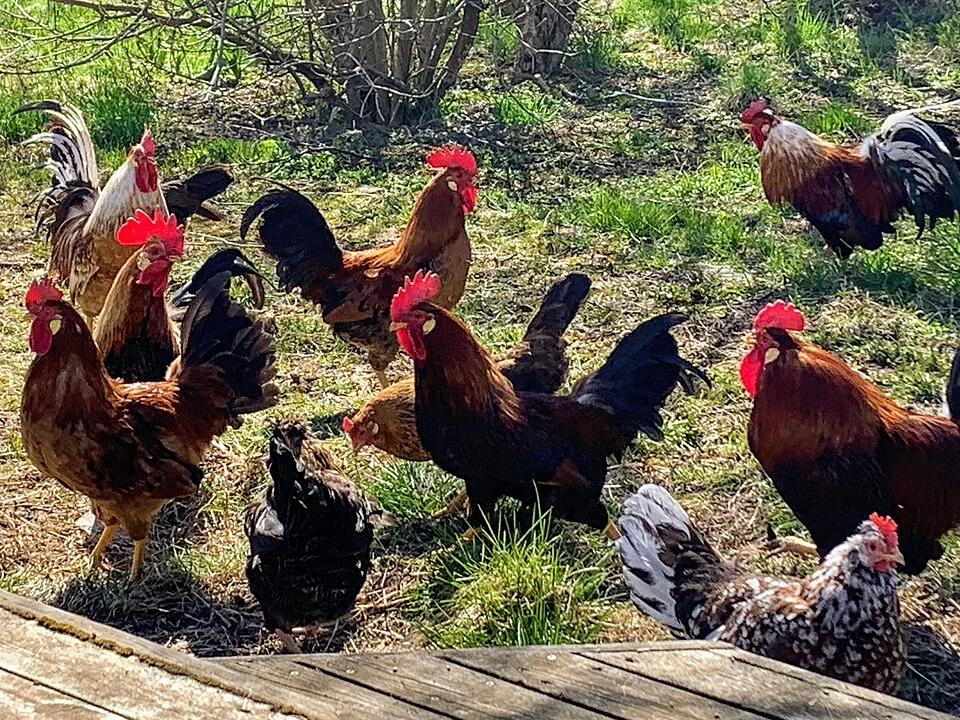
Icelandic chickens trace their history to the country's early farming settlements. They are a landrace: selection emphasized survival and usefulness across farms rather than conformity to one narrow feather-color standard. Later imported chickens and crossing threatened that distinct population, prompting preservation work.
That history changes the buying and breeding question. A varied-looking flock can be correctly Icelandic, while an attractive Icelandic cross is not the same preservation stock. Documented origin is more useful than insisting that every bird match a single gallery photograph.
Feather colors, patterns, comb forms and shank colors can vary. Some birds have a small crest and others do not. The Conservancy identifies clean legs and the absence of beard, muffs and ear tufts as relevant distinguishing observations.
The adults are relatively light compared with many large dual-purpose breeds. Our practical recommendation is to judge mature size, condition and landrace identity together. A small colorful bird is not automatically Icelandic, and a flock's varied appearance is not by itself evidence of recent crossbreeding.
The Conservancy describes roughly 180 eggs, strong foraging and broody ability. That is a population reference rather than a uniform exhibition-line guarantee. Preserve recorded ancestry when maintaining this landrace.
The cited reference does not establish one fixed first-egg age for this varied population. Record hatch date, growth and first laying in your own flock. That gives a more useful comparison than imposing a standardized breed's development chart on a landrace.
Our suggested yearly record includes eggs, broodiness and replacement-chick survival. The annual egg reference describes useful farm performance, not a specialized commercial layer. Assess the actual birds across seasons if winter eggs or natural flock replacement are central to your plan.
Icelandics are active foragers and may become familiar with people through early handling. They can fly and choose elevated resting places. Their traditional farm background should not be interpreted as a guarantee of either cuddling or predator escape.
Our recommendation is to establish a dependable evening routine and a secure inspection area. Observe how the actual flock behaves rather than assuming a single temperament for every landrace family. Birds comfortable exploring a large space still need to be retrievable for ordinary care and inspection.
Icelandics are best considered with useful ranging or activity space, not a tiny bare enclosure. Our suggested setup combines that movement with protected resting places and a predictable nighttime coop. Plan containment around actual flight ability rather than adult weight alone.
Cold-climate adaptation does not remove the need for dry shelter or winter water. In warmer locations, check shade and airflow as carefully as winter protection. Foraging is a behavior to support, not a nutritional calculation that lets you assume the yard supplies everything the flock needs.
Maintain the landrace rather than standardizing away its variation
Preservation breeding needs recorded source families and protection from unplanned outside matings. A cross may be useful for another backyard goal, but its offspring should not be labeled as the conserved Icelandic landrace. Keep that distinction visible in eggs offered for hatching.
Our suggested records emphasize family origin, sound development, reproduction, laying and mothering. Do not discard useful variation merely to make every bird the same color. Retaining several family contributions and the practical landrace characteristics is more meaningful than producing a visually uniform display flock.
A lively landrace for a preservation-minded keeper
Icelandic suits someone who appreciates a varied flock, active foraging and natural replacement potential. It is less convenient when a precise show variety, an extremely small enclosure or uniform appearance is required. Choose recorded preservation stock if landrace conservation is your goal. If your priority is simply colorful backyard chickens, a clearly labeled mixed flock can meet that separate aim.
Preserve documented landrace ancestry when breeding. Plan secure ranging for active birds; appearance alone cannot establish an Icelandic bird's identity or purity.
These priorities apply the breed traits above to a backyard setup. Use the chick-to-coop planner for young birds and the housing guides for your coop plan.
Questions keepers ask
Why do Icelandics look so different from one another?
Variation is part of the landrace's history. Selection emphasized farm usefulness rather than one narrow color pattern. Parentage and source identity matter more than matching every bird to a single representative photograph. [1]
Can I cross them and still call the chicks Icelandic?
For preservation purposes, no. Keep outside crosses clearly labeled and separate from the conserved landrace project. A useful crossbred chicken and a landrace breeding bird serve different purposes. [1]
Does foraging mean I can stop providing balanced feed?
No. A bird's foraging skill does not establish the nutrients available in your yard. Keep the feeding plan dependable and treat range access as activity and a variable supplement rather than a guaranteed complete ration. [7]
Are all Icelandic hens broody?
No. The source describes mothering as a retained landrace trait, but individuals differ. Record which hens complete incubation and raise chicks if natural replacements are part of your flock plan. [1]
Reviewed October 7, 2026. Breed organizations, university references and conservation histories establish breed traits; hatchery estimates describe named supplier lines. This profile identifies the source of the figures instead of treating them as one standardized trial.
Our care recommendations and suggested records apply those traits and Extension husbandry guidance to a backyard flock. They are editorial advice, not results from a controlled breed trial. A breed reputation does not establish an individual bird's behavior, health or readiness to move outdoors.
Egg-size words are source descriptions, not measured carton grades. Adult weights refer to mature birds, not market or pullet weights. Conservation categories describe U.S. populations. Examples of varieties are not a complete list of every national registry's accepted colors.